
Marine & Boat Coating
Fast-set pure polyurea spray coating for boat hulls, ballast tanks, pontoons, fish holds, and offshore structures — a seamless, saltwater-resistant.
Marine & Boat Coating with Pure Polyurea: Equipment and Application Guide
Saltwater, ultraviolet radiation, mechanical abrasion, and constant immersion test every coating system placed on a vessel. Conventional epoxy and bituminous coatings crack under hull flexing, absorb moisture at holidays, and require days of cure time that haul-out schedules cannot afford. Sprayed pure polyurea solves those problems by forming a seamless, flexible, monolithic elastomer that bridges micro-cracks as the hull works, blocks saltwater corrosion at the substrate, and reaches service hardness within minutes of application. For marine contractors, that means shorter vessel out-of-water windows and a coating that stays intact through the abrasion of docking, grounding, and ice contact.
This page explains why pure polyurea is used for marine and boat coating, where it is applied on vessels and marine infrastructure, and which spray equipment handles the chemistry. Pioneer Spray manufactures the high-pressure, heated, plural-component machines that marine coating applicators rely on, including the hydraulic JYYJ-H-V8T, the compact JYYJ-H600PK, and the field-proven JYYJ-H-V6T.
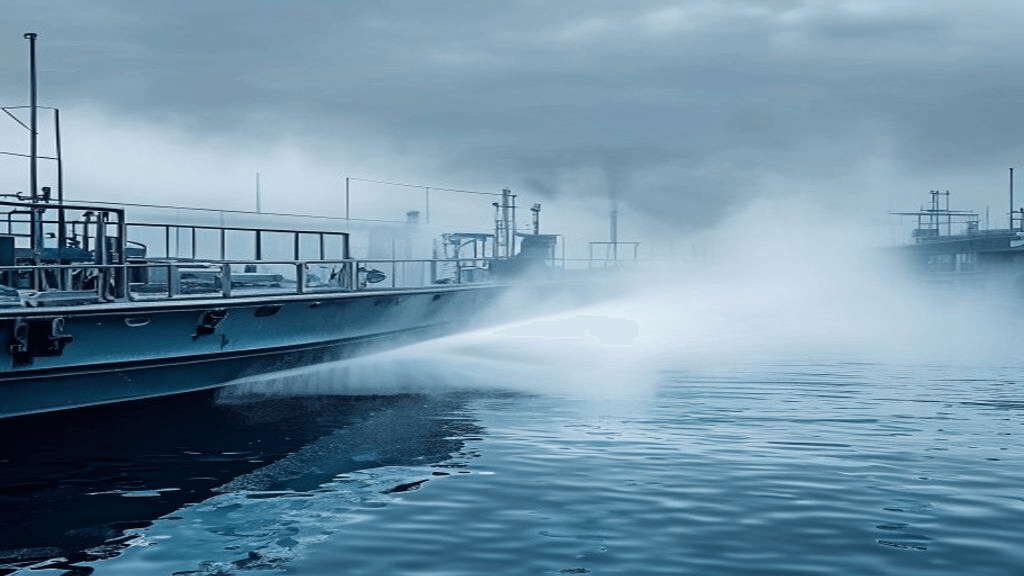
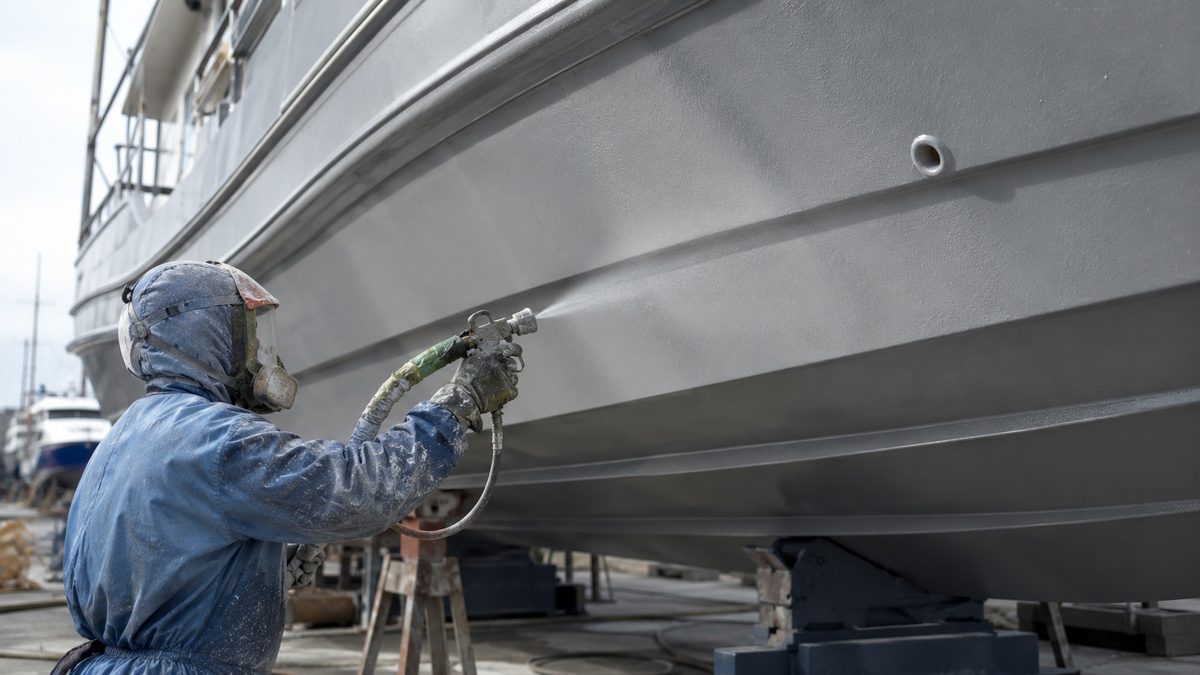
Why polyurea for marine and boat coating
The marine environment attacks coatings from every direction at once: saltwater corrodes bare steel and aluminium, UV degrades organic binders, wave action flexes the hull repeatedly, and marine organisms and barnacles find every pinhole through which to anchor. Pure polyurea addresses the full threat matrix with properties no single traditional coating matches.
- Seamless waterproof monolithic skin. Sprayed as a liquid, polyurea gels across the entire substrate in one continuous film with no seams, overlaps, or fastener holes through which water can track. Epoxy paint systems develop micro-cracks at film-to-film boundaries; a sprayed polyurea coat has none, meeting the waterproofing demands recognised in guidance such as EPA vessels and marinas guidance.
- Saltwater corrosion, abrasion, and impact resistance. A dense, closed polyurea film isolates the steel, aluminium, or GRP substrate from the ionic attack of seawater and the mechanical abrasion of dock contact, grounding events, and floating debris. High tensile strength combined with high elongation means the film absorbs impact without cracking rather than transferring the stress to the substrate.
- Fast cure — vessel back in water sooner. Pure polyurea gels in seconds and is walkable within minutes. Haul-out time for a recoat or new application can be measured in hours rather than the one to three days that slow-cure epoxy systems demand, reducing the cost of yard time and lost operating days.
- Flexible elastomer handles hull flex and thermal cycling. A steel or aluminium hull expands and contracts with temperature and deflects under sea loads every passage. A rigid coating fractures at those stress points; polyurea elongates with the substrate and recovers, maintaining the continuous waterproof barrier through thermal cycling and structural flex without micro-cracking. This elastomeric behaviour also satisfies corrosion-protection coating requirements described in standards such as the ISO corrosion-protection coating standard.
Where it is used
Boat Hulls & Decks
The external hull and topside deck are the most exposed surfaces on any vessel. A sprayed pure polyurea coat provides a tough, abrasion-resistant waterproof skin over steel, aluminium, or GRP that resists dock abrasion, grounding, and wave impact while remaining flexible through the full range of hull-flex and thermal cycles the vessel sees in service.
Ballast Tanks & Bilges
Ballast tanks and bilge compartments hold seawater for trim, making them one of the most corrosion-aggressive environments on a vessel. A seamless polyurea lining eliminates the pinholes and weld-seam gaps where corrosion initiates in conventional paint systems, providing a continuous waterproof barrier that resists the cyclical wetting and drying that accelerates coat breakdown.
Pontoons & Floating Docks
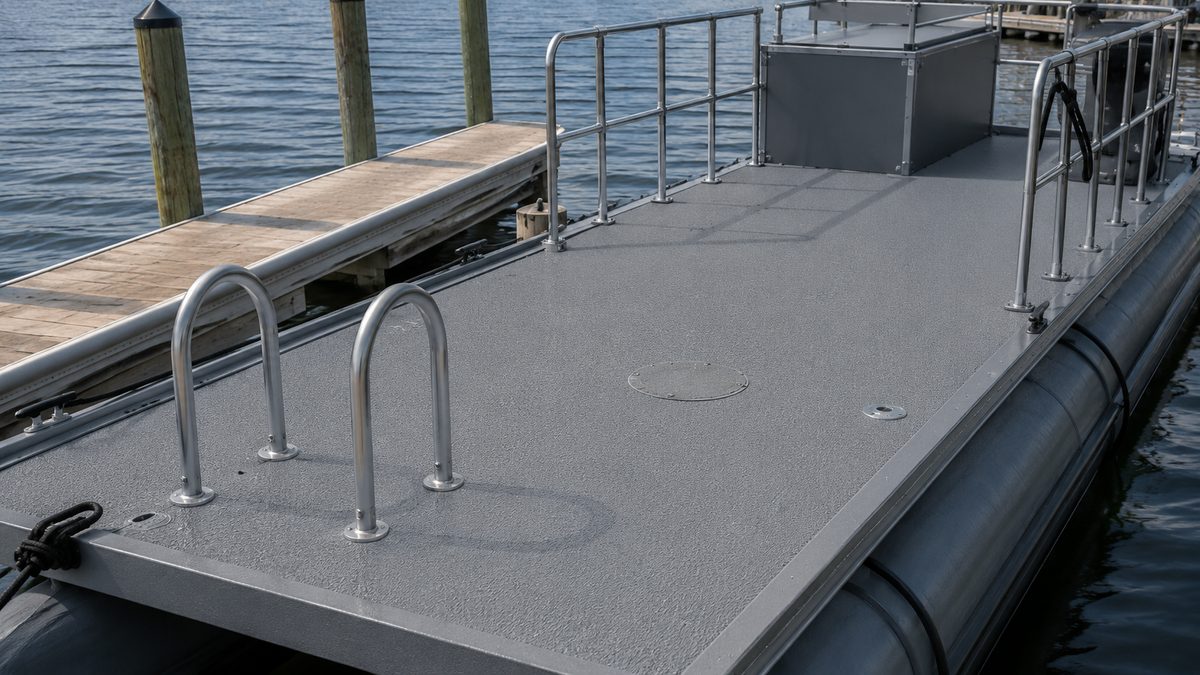
Pontoon hulls and floating dock structures face constant immersion, wave abrasion, and UV exposure above the waterline. Sprayed polyurea follows the curved geometry of pontoon tubes and dock frames, building a seamless, buoyant protective skin that resists fatigue cracking through the repetitive flex of wave loading better than rigid paints or fibreglass wraps.
Fish Holds & Live Wells
Fish hold interiors and live-well tanks require a coating that is simultaneously waterproof, abrasion-resistant for catch handling, and compatible with the hygienic requirements of seafood contact surfaces. Polyurea forms a smooth, non-porous lining free of joints where odour and bacteria accumulate, and its chemical resistance handles the acids and brine typical of fish storage environments.
Offshore Platforms & Structures
Offshore platforms, jacket legs, caissons, and splash-zone structures are subjected to the most severe marine corrosion environment: permanent salt spray, wave impact, UV, and biofouling. A high-build polyurea protective coating provides the film thickness and elasticity to resist all of these simultaneously, protecting structural steel where conventional coatings fail within seasons.
Marine Flotation & Buoyancy Foam
In addition to protective surface coatings, closed-cell polyurethane flotation foam is used to fill voids in boat hulls, pontoons, and dock modules to provide permanent buoyancy. This rigid, closed-cell PU foam does not absorb water and retains its buoyancy force even if the outer hull is breached, a safety-critical application in small craft and dock construction.
The application process
Applying pure polyurea marine coatings is a two-component process where surface preparation and machine settings together determine whether the coating lasts five years or twenty. The steps are controlled and consistent regardless of vessel type.
- 1. Surface preparation and primer selection. Steel substrates are abrasive-blasted to a clean profile; GRP (fibreglass) and aluminium surfaces are abraded and degreased. A marine-grade polyurea primer compatible with the chosen polyurea system is applied and allowed to flash before spraying begins. Correct primer choice for the substrate — steel, aluminium, or GRP — is what prevents delamination under the hydrostatic and flex loads a hull experiences.
- 2. Machine heating and pressure setup. The plural-component machine heats both the isocyanate and polyol/amine resin components to the polyurea supplier's recommended temperature — typically in the 60 to 70°C range — and pressurises the system to 25 to 36 MPa. At this pressure and temperature the two streams impinge-mix inside the gun and atomise correctly, producing the fast, complete reaction that gives polyurea its gel speed and final-film properties.
- 3. Spray to specified build thickness. Polyurea is applied in controlled passes to the film thickness the duty requires: typically 40 to 80 mils (1 to 2 mm) for hull waterproofing and splash-zone protection, with heavier builds of 80 to 120 mils (2 to 3 mm) or more for ballast tank lining and offshore structure coating where abrasion and immersion loads are highest.
- 4. Topcoat and inspection where required. Where UV color stability matters — above-waterline topsides, decks, and offshore structures in direct sunlight — an aliphatic polyurea or polyurethane topcoat is applied over the aromatic polyurea body coat to prevent chalking and color shift. After application, dry-film thickness is gauged and a holiday (pinhole) test confirms the waterproof barrier is complete before the vessel is returned to the water.
The equipment you need
Pure polyurea cannot be applied with low-pressure or unheated spray equipment. The chemistry is a 1:1 plural-component system that gels in seconds at the impingement point; without the heat and pressure that drives complete mixing and atomisation, the result is under-reacted, tacky, or delaminating film that fails under immersion. Pioneer Spray machines operate in the 25 to 36 MPa range and heat both component streams to the 60 to 70°C needed to spray fast-set pure polyurea reliably on marine substrates.
For larger vessels, offshore work, and high-output ballast tank lining jobs, the hydraulic JYYJ-H-V8T delivers the flow and pressure stability to spray thick builds across large hull and tank surfaces without starving the gun mid-pass. For smaller craft, pontoon coating, and marine maintenance crews with limited generator capacity, the JYYJ-H-V6T and the compact JYYJ-H600PK provide the same heated high-pressure performance in a lighter package suited to boatyard and marina environments. The same machines used for marine polyurea are also the standard choice for truck bed liner and tank lining contractors who operate across multiple application sectors.
Not sure which JYYJ model suits your vessel type, your polyurea supplier's requirements, or your on-site power supply? Contact our engineers and we will configure a machine, heated hose, and gun package for your marine coating application.
Frequently Asked Questions
Which Pioneer Spray machine is best for marine and boat coating?
For large hull areas, ballast tanks, and offshore structures where high output and pressure stability matter most, the hydraulic JYYJ-H-V8T is the standard choice. The JYYJ-H-V6T and JYYJ-H600PK handle the same pure polyurea chemistry in a more portable package suited to smaller craft, marina maintenance, and pontoon coating where generator capacity and deck space are limited. All three models operate in the 25 to 36 MPa range and heat both components to the 60 to 70°C that fast-set marine polyurea requires.
Can polyurea be applied over existing antifouling or epoxy paint?
Polyurea should be applied over a properly prepared, primed substrate rather than directly over old antifouling or soft epoxy coats. Old coatings must be removed or abraded to a sound surface, and a compatible marine primer must be applied to ensure adhesion. Your polyurea material supplier will specify the primer system; Pioneer Spray configures the machine to the material so it sprays and cures on spec over the prepared surface.
Does polyurea replace antifouling bottom paint on boat hulls?
Pure polyurea provides corrosion protection, abrasion resistance, and waterproofing for hull structures but does not contain biocides, so it does not replace antifouling paint as a separate topcoat system on below-waterline surfaces in fouling-prone waters. Many marine operators use polyurea as a primary structural barrier coating and apply a biocide antifouling topcoat over it, combining the structural durability of polyurea with the fouling-release properties of a dedicated antifouling system.
What film thickness is typical for marine polyurea coating?
Hull waterproofing and splash-zone coating are typically applied at 40 to 80 mils (1 to 2 mm). Ballast tank lining, bilge coating, and offshore structure protection that face permanent immersion and abrasion are built to 80 to 120 mils (2 to 3 mm) or heavier. The aliphatic UV-stable topcoat for above-waterline surfaces is usually 10 to 20 mils (0.25 to 0.5 mm) over the aromatic body coat. Dry-film thickness is verified with a gauge after application.
New to the material? Read our guide to what polyurea lining is, where it is used and the equipment it needs.
Recommended JYYJ Machines
JYYJ-H-V8T
Pioneer's top-tier flagship — the highest-output PLC-controlled spray machine in the JYYJ line. 2-15 kg/min at 36 MPa with 10-inch PLC touchscreen, one-click start/stop operation, and low-temperature protection that prevents incomplete mixing in cold conditions. Flat-mounted booster pump design reduces footprint while maintaining the highest output. Ideal for the most demanding industrial polyurea and polyurethane projects.
JYYJ-H600PK
Adjustable-ratio hydraulic spray machine with 7-inch PLC touchscreen and adjustable mixing ratio (1:1~1:2). 2-10 kg/min at 36 MPa for polyurea, high-density foam, and precision-critical applications. Recipe memory and data logging for project documentation. Adjustable ratio handles temperature-driven viscosity shifts and custom material formulations — unique in the JYYJ line.
JYYJ-H-V6T
Hydraulic workhorse with 7-inch PLC touchscreen control. 2-10 kg/min at 36 MPa, 105 m insulated pipe support, and intelligent automation. Ideal for contractors who need precision control without flagship pricing — the sweet spot between H600 entry and H600PK flagship.
Recommended Materials
Browse Polyurea Coating (A + B) →- ● Fast-set pure polyurea marine coating (1:1, gels in seconds, seamless waterproof elastomer)
- ● Abrasion-grade polyurea for decks and bilges (high tensile strength, high elongation)
- ● Aliphatic UV-stable polyurea topcoat for sun-exposed hulls and decks (color-stable, chalking-resistant); note: closed-cell PU flotation foam also available for buoyancy fill applications
Why This Setup Works
Seamless waterproof monolithic skin — no seams, bolt holes, or laps for saltwater to track
Saltwater corrosion, abrasion, and impact resistance for steel, aluminium, and GRP substrates
Fast cure in minutes — vessel back in service the same day, shorter haul-out windows
Flexible elastomer elongates with hull flex and thermal cycling without micro-cracking
Technical Considerations
- Abrasive-blast steel or properly abrade and degrease GRP/aluminium; apply correct marine primer before spraying
- Use aliphatic polyurea topcoat where UV color stability matters on above-waterline and deck surfaces
- Typical build 40–80 mils (1–2 mm) hull/splash zone; 80–120 mils (2–3 mm) ballast tanks and offshore structures
- Pure polyurea requires 1:1 ratio, 60–70°C component heat, and 25–36 MPa high-pressure plural-component machine
Real Projects in Marine & Boat Coating
Projects for this application are being documented. Share your project requirement and we'll send relevant reference cases.
See Marine & Boat Coating in Practice
YouTube demonstration videos
@YongjiaPolyurethanemachinepuFrequently Asked Questions
What JYYJ machine is best for marine & boat coating?
Do you supply the raw materials too?
How long is shipping to Russia / LATAM / Middle East?
Do you provide technical training and installation support?
What certifications does the equipment have?
Planning a marine & boat coating project?
Share your output, voltage, and project scale. Pioneer recommends a matched JYYJ machine + material combination within 24 hours.