
Polyurea Tunnel Lining Spray Equipment
Fast-set pure polyurea for road and rail tunnel lining — seals inflow, stops spalling and falling block, cures in minutes for night closure windows. Sprayed by Pioneer JYYJ high-pressure machines (25–36 MPa).
Polyurea Tunnel Lining: Equipment and Application Guide
Road and rail tunnels age from the inside out. Groundwater finds every crack and construction joint in the concrete lining, carbonation and freeze-thaw cycles chip away at the surface, and eventually chunks of concrete can spall and fall onto the roadway or track below. Because most tunnels stay open around the clock, contractors get only a narrow overnight or off-peak closure window to make repairs — and pure polyurea, which gels in seconds and is load-ready within minutes, is one of the few coatings that can seal, waterproof, and structurally reinforce a lining inside that window.
This page explains why sprayed polyurea is used for tunnel lining, where it is applied, and what equipment the job requires. Pioneer Spray builds the heated, high-pressure, plural-component machines that tunnel-lining contractors run with long heated hose sets to reach deep into a bore, including the hydraulic JYYJ-H-V8T.
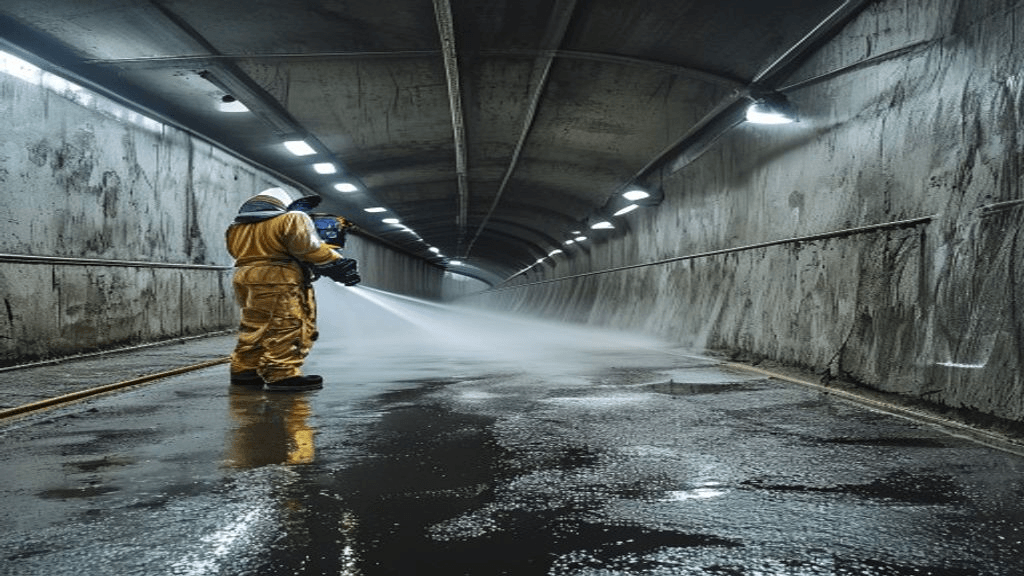
Why polyurea is used for tunnel lining protection
A tunnel lining has to resist groundwater pressure, traffic vibration, and decades of chemical attack from de-icing salt and carbonation, all while the structure itself keeps moving slightly with temperature and load. Few coatings can do all of that in a single pass, which is why sprayed polyurea has become the standard according to FHWA-referenced tunnel rehabilitation guidance and comparable transit-agency specifications.
- Seamless waterproofing membrane. Sprayed in place, polyurea forms one continuous, monolithic skin over the whole lining surface with no seams or laps for groundwater to track along, stopping inflow at cracks, construction joints, and cold joints that sheet membranes cannot seal from the exposed face.
- High elongation follows movement and cracking. Tunnel linings shift with thermal cycling, settlement, and live load. Polyurea's high elongation lets the membrane stretch and bridge hairline cracks that open after application instead of splitting like a rigid coating.
- Stops spalling and falling block. Where carbonation or rebar corrosion has already weakened the concrete cover, a sprayed polyurea skin holds loose material in place, containing spall fragments instead of letting them drop onto the roadway or rail bed below.
- Minutes, not days, to cure. Pure polyurea gels in seconds and is tack-free and serviceable within minutes, letting a crew line hundreds of square meters and reopen the bore before the next morning's traffic, inside a single overnight closure.
- Chemical and abrasion resistance. A dense closed-cell polyurea film resists de-icing salt, exhaust chemistry, and the low-level abrasion of tunnel traffic, protecting the concrete substrate long after cure, consistent with the durability principles behind ISO 12944 protective coatings guidance.
Where polyurea tunnel lining is used
Crown and Sidewall Waterproofing
The tunnel crown and sidewalls are sprayed with polyurea to form a continuous waterproofing membrane over cast-in-place or shotcrete lining, sealing active leaks and construction-joint inflow across the whole bore.
Spalling and Falling-Block Prevention
Aging concrete lining with carbonation or corrosion damage is sprayed to contain loose cover concrete, holding deteriorated material against the substrate so it cannot spall or fall onto traffic below.
Segment Joint and Crack Sealing
Precast segment joints, construction joints, and shrinkage cracks are treated with a polyurea overlay that bridges movement and blocks the water path that widens joints over time.
Portal and Approach Structures
Tunnel portals, cut-and-cover approaches, and ventilation shafts are lined with polyurea for the same waterproof, abrasion-resistant protection as the main bore, extending coverage to the transition structures.
Emergency and Utility Cross-Passages
Cross-passages, drainage galleries, and utility niches are coated to stop water ingress in confined spaces where fast cure and low-VOC application matter most.
Rail Tunnel Refurbishment
Rail tunnel linings are resprayed during possession windows to renew waterproofing and structural containment without the multi-day cure times that would extend a track closure.
The tunnel lining application process
Spraying pure polyurea inside a bore is a controlled, two-component process where surface prep and active-leak management often decide the outcome as much as the spray pass itself.
- 1. Substrate preparation. The concrete surface is prepared by abrasive blasting or high-pressure water jetting to a sound, laitance-free profile such as CSP 3-5, with delaminated or spalled concrete removed and patched before coating.
- 2. Moisture and active-leak control. Running water and active leaks are located and stopped first, typically with hydrophilic or fast-set cementitious plugs, and residual substrate moisture content is checked against the coating manufacturer's limit before spray.
- 3. Machine setup and long-hose delivery. The plural-component machine heats the isocyanate and resin sides to roughly 60-70°C and pressurizes them to spec, holding a precise 1:1 ratio through heated hose runs of 100 meters or more to carry the material deep into the bore without losing temperature or pressure at the gun.
- 4. Spray to target thickness and cure verification. Polyurea is sprayed in controlled passes to build a continuous membrane, commonly 2 to 4 mm, then checked with a wet-film or dry-film gauge and a visual holiday check before the closure window ends and traffic returns.
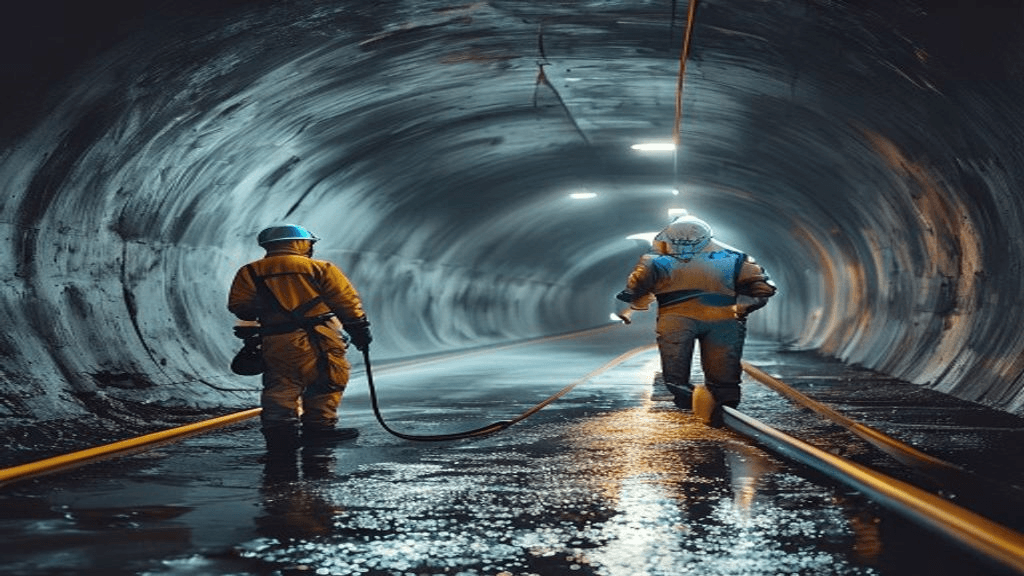
The equipment you need: high-pressure, long-reach plural-component machines
Pure, fast-set polyurea cannot be applied with low-pressure or unheated equipment, and a tunnel bore adds a second constraint: the machine and hoses have to carry heated, pressurized material tens or hundreds of meters from the truck or trailer staged at the portal to the working face. Pioneer Spray machines operate in the 25 to 36 MPa range with heated hose sets built for long-distance runs, so material stays in spec all the way to the gun.
Low-pressure kits cannot hold ratio and temperature over a long hose run, which is exactly the failure mode a tunnel job cannot tolerate mid-shift inside a closure window. For deep-bore tunnel lining, the hydraulic JYYJ-H-V8T and JYYJ-H-V6T deliver the stable high pressure and heated-hose reach the work demands, while the JYYJ-H600PK suits shorter cross-passage and portal work.
Not sure which JYYJ model and hose length fits your tunnel's bore length, closure window, or portal staging area? Contact our engineers and we will recommend a machine, hose, and gun configuration for your project.
Frequently Asked Questions
Which Pioneer Spray machine is best for tunnel lining?
For deep-bore road and rail tunnels, the hydraulic JYYJ-H-V8T and JYYJ-H-V6T are the usual choice because they hold stable high pressure and heat through long hose runs to the working face. The JYYJ-H600PK is a good fit for shorter portal, cross-passage, or shaft work where hose runs are under 100 meters.
How long can the heated hose run into a tunnel bore?
Pioneer Spray configures heated hose sets in the 100-meter-plus class for tunnel work, with the exact run determined by machine pressure capacity and closure logistics. Our engineers size the hose length and diameter to your specific bore length and staging setup.
Do you supply the polyurea material as well?
Pioneer Spray manufactures the spray machines, hoses, and guns rather than the chemical. We work with your existing tunnel-grade polyurea supplier and configure the machine heat, pressure, and ratio to that specific material so it sprays and cures on spec.
What polyurea thickness is typical for tunnel lining?
Tunnel waterproofing and spall-containment membranes are commonly applied at 2 to 4 mm, with thickness confirmed by a gauge before the closure window ends. Actual thickness targets should follow the project engineer's specification and substrate condition.
Can tunnel lining be sprayed during a single overnight closure?
Yes, that is the main reason pure polyurea is chosen for tunnel work. It gels in seconds and is serviceable within minutes, so a crew can prep, spray, and reopen a section within a single overnight or off-peak closure window instead of the multi-day cure times of epoxy or cementitious systems.
Is polyurea tunnel lining research supported by transport authorities?
Tunnel lining rehabilitation with sprayed elastomeric membranes has been studied by transport research bodies, including work referenced by rail technical research organizations on polyurea spray-lining methods for tunnel refurbishment, alongside general guidance from agencies such as FHWA on tunnel structure maintenance.
New to the material? Read our guide to what polyurea lining is, where it is used and the equipment it needs.
Also lining municipal structures? See our page on polyurea manhole and sewer lining.
Above ground, the same spall-containment mechanism protects hardened structures against explosive overpressure — see our page on polyurea blast-mitigation coating.
Recommended JYYJ Machines
JYYJ-H-V8T
Pioneer's top-tier flagship — the highest-output PLC-controlled spray machine in the JYYJ line. 2-15 kg/min at 36 MPa with 10-inch PLC touchscreen, one-click start/stop operation, and low-temperature protection that prevents incomplete mixing in cold conditions. Flat-mounted booster pump design reduces footprint while maintaining the highest output. Ideal for the most demanding industrial polyurea and polyurethane projects.
JYYJ-H-V6T
Hydraulic workhorse with 7-inch PLC touchscreen control. 2-10 kg/min at 36 MPa, 105 m insulated pipe support, and intelligent automation. Ideal for contractors who need precision control without flagship pricing — the sweet spot between H600 entry and H600PK flagship.
JYYJ-H600PK
Adjustable-ratio hydraulic spray machine with 7-inch PLC touchscreen and adjustable mixing ratio (1:1~1:2). 2-10 kg/min at 36 MPa for polyurea, high-density foam, and precision-critical applications. Recipe memory and data logging for project documentation. Adjustable ratio handles temperature-driven viscosity shifts and custom material formulations — unique in the JYYJ line.
Recommended Materials
Browse Polyurea Coating (A + B) →- ● Pure fast-set polyurea elastomer (1:1, gels in seconds) for waterproofing membranes
- ● High-elongation polyurea for crack-bridging and spall containment
- ● Optional aliphatic topcoat where lining is exposed to lighting/UV and color stability matters
Why This Setup Works
Seamless monolithic membrane stops groundwater inflow at cracks and construction joints
High elongation bridges movement and hairline cracking without splitting
Contains spalled and loose concrete, preventing falling block onto traffic below
Gels in seconds and is serviceable in minutes — fits single overnight closure windows
Technical Considerations
- Typical membrane build 2-4 mm depending on project specification
- Concrete must be blasted to sound profile (CSP 3-5) with active leaks stopped before spray
- Long heated hose runs (100m-class) needed to reach deep into the bore from portal staging
- Verify wet/dry-film thickness and run a holiday check before reopening to traffic
Real Projects in Polyurea Tunnel Lining Spray Equipment
Projects for this application are being documented. Share your project requirement and we'll send relevant reference cases.
See Polyurea Tunnel Lining Spray Equipment in Practice
YouTube demonstration videos
@YongjiaPolyurethanemachinepuFrequently Asked Questions
What JYYJ machine is best for polyurea tunnel lining spray equipment?
Do you supply the raw materials too?
How long is shipping to Russia / LATAM / Middle East?
Do you provide technical training and installation support?
What certifications does the equipment have?
Planning a polyurea tunnel lining spray equipment project?
Share your output, voltage, and project scale. Pioneer recommends a matched JYYJ machine + material combination within 24 hours.