
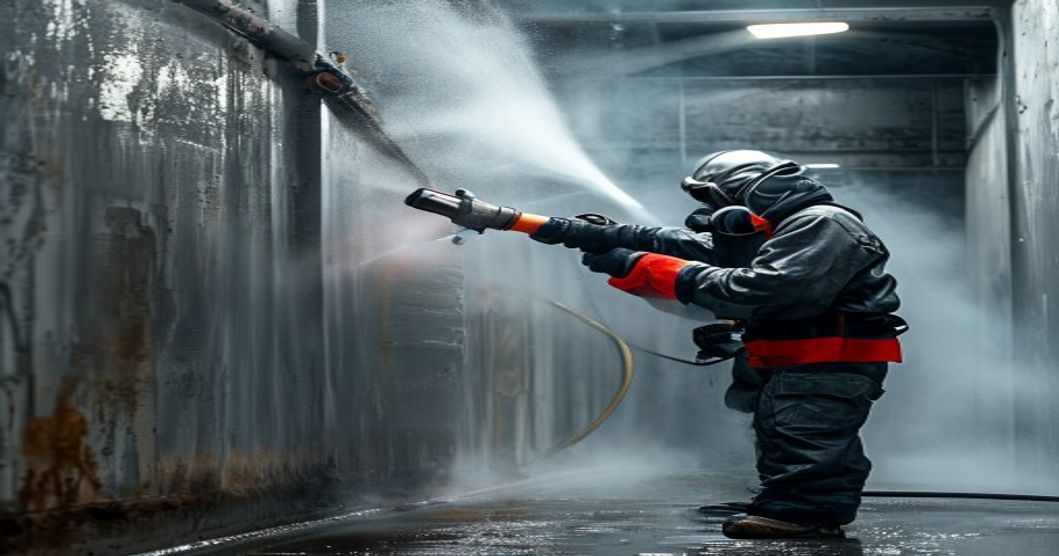
Quick answer. A polyurea lining is a seamless, fast-curing protective membrane sprayed onto steel, concrete, or geotextile surfaces to resist abrasion, corrosion, chemicals, and water. It is applied hot as a two-component (1:1) system through high-pressure plural-component spray equipment, gels in seconds, and can be walked on within an hour — making it the go-to liner for tanks, secondary containment, pipes, mining wear parts, and waterproofing.
What Is Polyurea, Exactly?
Polyurea is an elastomer formed by the reaction of an isocyanate component (Side A) with an amine-terminated resin blend (Side B). Unlike conventional coatings that rely on solvent evaporation or slow moisture curing, polyurea cures through an almost instantaneous chemical reaction. The two liquids meet only at the spray gun, mix at a 1:1 volume ratio, and set within 3–15 seconds — which is why the material must be sprayed by dedicated heated, high-pressure equipment rather than brushed or rolled.
The result is a monolithic, jointless membrane typically 1.5–3 mm (60–120 mil) thick that bonds to properly prepared substrates and flexes with them. Because it contains little or no VOC and no solvent, a thick coat can be built in a single pass, and the finished liner is ready for service faster than almost any competing system.
Polyurea vs. Polyurethane vs. Epoxy
Buyers often confuse these three chemistries. All three protect surfaces, but their cure behavior and performance differ sharply. Polyurea is prized for speed and elongation; epoxy for hardness and chemical resistance at low cost; polyurethane sits in between. The table below summarizes the practical trade-offs for lining work.
| Property | Polyurea | Polyurethane | Epoxy |
|---|---|---|---|
| Gel / set time | 3–15 seconds | Minutes to hours | Hours to days |
| Return to service | ~1 hour | Several hours | 24–72 hours |
| Elongation | 200–500% | 100–300% | 2–5% (brittle) |
| Abrasion resistance | Excellent | Good | Fair |
| Moisture / humidity tolerance during cure | High (insensitive) | Sensitive | Sensitive |
| Application temperature window | Wide (down to sub-zero) | Moderate | Narrow (needs warmth) |
| Seamless single-pass build | Yes (thick) | Limited | Multiple thin coats |
| Equipment required | Heated high-pressure plural-component rig | Low/high-pressure | Roller / low-pressure |
The takeaway: if a project needs waterproofing plus crack-bridging flexibility and a same-day return to service, polyurea wins. If the priority is a cheap chemical-resistant floor with no rush, epoxy is often adequate. The catch with polyurea is that its speed demands proper machinery — the reason equipment selection is central to any polyurea program.
Key Properties That Define a Polyurea Liner
- Fast-set chemistry: tack-free in seconds, walk-on in about an hour — minimal downtime for tanks and floors in service.
- Seamless membrane: no laps, welds, or joints where leaks and undercutting corrosion start.
- Abrasion resistance: outperforms rubber and epoxy in slurry, ore, and high-flow environments; often verified with Taber abrasion testing per ASTM D4060.
- Chemical & corrosion resistance: withstands a broad range of acids, alkalis, hydrocarbons, and salt water, protecting steel and concrete substrates.
- High elongation (200–500%): bridges hairline cracks and moves with thermal expansion or structural settlement without splitting.
- Waterproof & root-resistant: a fully bonded, pinhole-free barrier for water and wastewater containment.
Major Polyurea Lining Applications
Because polyurea combines toughness with flexibility, it is specified across heavy industry, infrastructure, and water management. The most common lining categories are below — each links to a detailed application page.
- Tank lining equipment: internal linings for storage tanks and process vessels holding water, chemicals, or fuels — rebuilds corroded steel and delivers a seamless barrier.
- Secondary containment: berms, bund walls, and dike floors that must retain spills. In the U.S. these areas fall under EPA Spill Prevention, Control, and Countermeasure rules; see the EPA SPCC program for requirements a compliant liner helps satisfy.
- Mining wear lining: chutes, hoppers, screens, and slurry pipe protected against abrasive ore and reduced noise.
- Pond & canal lining: geotextile-backed spray-in-place liners for reservoirs, irrigation canals, and containment ponds.
- Pipe & pipeline coating: internal and external corrosion and abrasion protection for steel and concrete pipe.
- Marine & boat coating: hulls, decks, pontoons, and dock structures shielded from salt water, UV cracking, and impact.
- Manhole & wastewater lining: rehabilitates deteriorated concrete manholes and sewer structures with a monolithic, H2S-resistant membrane.
What Equipment Do You Need to Spray Polyurea?
This is where most polyurea projects succeed or fail. Because the two components react in seconds, they cannot be pre-mixed in a bucket. They must be pumped separately, heated, and combined at the gun. A proper polyurea rig is a plural-component (two-component), high-pressure, heated spray system with these core capabilities:
- High pressure: typically 25–36 MPa (roughly 2,500–5,000 psi) so the fast-reacting components atomize and mix instantly at the gun.
- 1:1 volumetric metering: precise, balanced delivery of Side A and Side B — off-ratio material never fully cures.
- Integrated heat: primary heaters bring each component to 60–80°C, plus a heated hose to hold temperature all the way to the gun, lowering viscosity for clean atomization.
- Impingement mix gun: the two streams collide inside the gun chamber, not in the air, producing a uniform membrane.
Pioneer Spray builds complete turnkey polyurea systems — proportioner, heated hose, spray gun, and controls in one package — engineered to match the output of premium brands such as Graco Reactor and PMC at a substantially lower cost. For high-volume tank and containment work, the JYYJ-H-V8T hydraulic proportioner delivers the throughput contractors need for large surface areas in a single mobilization. Crews handling mixed pipe, mining, and marine jobs often pair the JYYJ-H-V6T for its balance of output and portability, while the JYYJ-H600PK offers a rugged, self-contained option for remote sites. Complete machines range from roughly $3,250 to $11,200 — a fraction of comparable imported rigs, with no compromise on pressure, heat, or ratio accuracy.
How to Choose the Right Polyurea Lining System
- Define the substrate and exposure. Steel tanks, concrete containment, and geotextile ponds each demand different primers and film thickness.
- Estimate daily throughput. Large containment areas favor a high-output hydraulic proportioner; smaller repair crews can run a compact electric unit.
- Confirm power and site logistics. Remote sites without stable grid power need generator-friendly or self-contained rigs.
- Verify heat and pressure specs. Ensure the machine holds 25–36 MPa and full component temperature through the hose — under-heated material sprays rough and off-ratio.
- Plan operator safety. Isocyanates require respiratory protection and ventilation; follow the guidance in the OSHA isocyanates standard for spray operations.
A turnkey package removes the guesswork: the proportioner, hose, and gun are matched at the factory so ratio, pressure, and temperature stay in spec from the first pull of the trigger.
FAQ
Q: Is polyurea the same as polyurethane?
No. Polyurea cures through an isocyanate–amine reaction in seconds and is insensitive to humidity, while polyurethane cures more slowly through an isocyanate–polyol reaction and is more moisture-sensitive. Polyurea offers higher elongation and faster return to service, which is why it dominates fast-turnaround lining work.
Q: Can I roll or brush polyurea instead of spraying it?
Generally no. Pure polyurea gels in 3–15 seconds, far too fast for hand application. It must be applied with heated, high-pressure plural-component spray equipment that mixes the two components at the gun. Slower hybrid formulations exist for hand work but sacrifice performance.
Q: How thick should a polyurea lining be?
Most protective linings are built at 1.5–3 mm (60–120 mil). Abrasion-heavy mining or containment jobs run at the upper end, while waterproofing membranes can be thinner. A single spray pass can achieve full thickness thanks to polyurea's fast build.
Q: How long before a polyurea-lined tank can return to service?
Polyurea is typically tack-free in under a minute and walk-on within about an hour. Depending on the chemistry and service medium, tanks can often be returned to service the same day — dramatically less downtime than epoxy, which may need 24–72 hours.
Q: How much does polyurea spray equipment cost?
Complete turnkey systems from Pioneer Spray range from about $3,250 to $11,200 depending on output, heating capacity, and configuration — well below comparable Graco or PMC rigs while matching pressure, 1:1 metering, and heat specifications.