
Polyurea Blast Mitigation & Impact-Resistant Coatings
Sprayed pure polyurea blast-mitigation coating for blast walls, hardened structures & anti-terrorism retrofits — >400% elongation absorbs shock and stops spalling, applied by Pioneer JYYJ high-pressure equipment (25–36 MPa).
Polyurea Blast Mitigation Coatings: Equipment and Application Guide
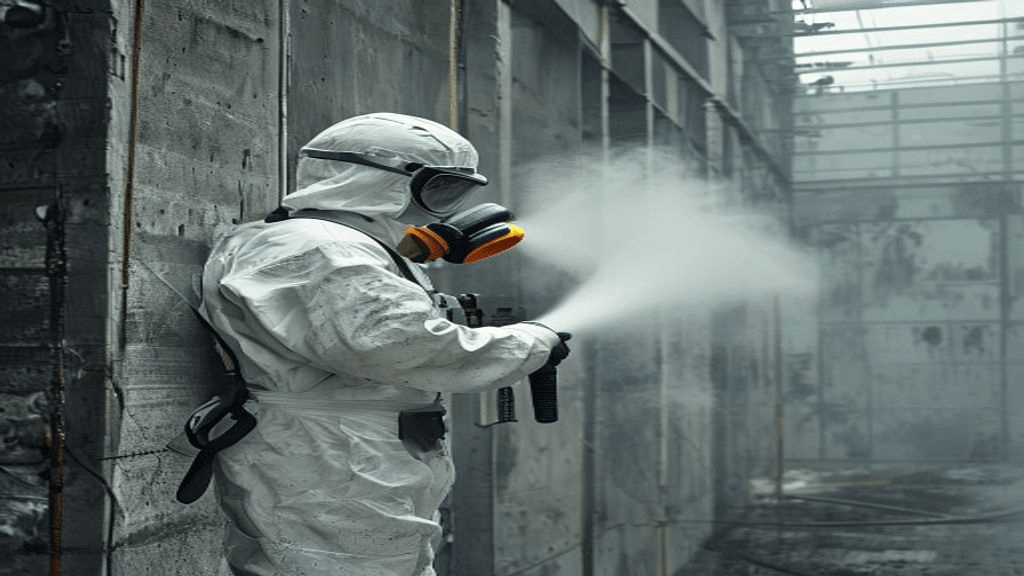
Government facilities, military installations, and petrochemical plants face a threat that ordinary construction materials were never designed to survive: the sudden overpressure and fragmentation of an explosive event. Bare concrete and masonry are brittle — under blast load they shatter and throw lethal fragments (spalling) long before the wall itself collapses. Sprayed pure polyurea has become the standard retrofit and new-build solution because it forms a tough, highly elastic membrane that absorbs the shock wave's energy and holds fractured debris together instead of letting it fly. Specifiers search for this system under several names — blast-proof coating, blast protection coating, and blast-mitigation coating — and on this page they all refer to the same sprayed pure-polyurea membrane.
This page explains how polyurea blast-mitigation coatings work, where they are specified, and what spray equipment the application requires. Pioneer Spray builds the high-pressure, heated, plural-component machines that blast-coating contractors rely on to apply anti-terrorism grade polyurea to spec, including the heavy hydraulic JYYJ-H-V8T.
Why polyurea is specified for blast mitigation
- Extreme elongation absorbs shock energy. Blast-grade polyurea elongates more than 400% before failure, letting the membrane stretch with the shock wave instead of shattering. Design guidance for blast-resistant construction is summarized by the National Institute of Building Sciences WBDG blast-resistant design resource.
- Stops spalling and secondary fragmentation. Unprotected concrete and masonry throw high-velocity fragments under blast load — often the leading cause of injury. A continuous polyurea liner on the interior (or exterior) face holds shattered material together instead of letting it become shrapnel.
- Seamless, full-coverage membrane. Sprayed in place with no joints or laps, polyurea leaves the blast wave no seam to exploit, unlike bolted panel systems or adhered sheet membranes.
- Fast application on occupied or time-critical sites. Pure polyurea gels in seconds and is tack-free in minutes, so government, military, and petrochemical facilities can be hardened in phases with minimal downtime.
- Supports anti-terrorism / force-protection design intent. Sprayed polyurea retrofits are widely specified to help structures meet force-protection and anti-terrorism design criteria referenced in guidance such as UFC 4-010-01, working alongside the security and infrastructure-protection framework published by CISA, the U.S. Cybersecurity and Infrastructure Security Agency.
Where polyurea blast-mitigation coatings are used
Blast Walls and Perimeter Barriers
Freestanding blast walls and perimeter barriers around government, military, and critical-infrastructure sites are sprayed with polyurea to absorb overpressure and contain fragments at the property line.
Government and Military Facility Retrofits
Existing masonry and concrete buildings on bases, embassies, and courthouses are retrofit with interior polyurea liners to raise blast resistance without a full structural rebuild.
Petrochemical and Process Buildings
Control rooms, blast-resistant modules, and occupied buildings near process units are coated to protect personnel from vapor-cloud explosion overpressure and flying debris.
Structural Hardening Against Progressive Collapse
Polyurea membranes applied to columns, beams, and connections help a structure hold together after a localized blast event, reducing the risk of progressive collapse.
Window Film Backup and Glazing Returns
Around blast-resistant glazing systems, polyurea is sprayed on wall returns and mullions to anchor catch systems and stop the frame from becoming a secondary hazard.
Bunkers, Guard Posts and Critical Infrastructure
Guard booths, bunkers, substations, and other hardened assets are coated inside and out for a continuous membrane that resists both blast overpressure and forced-entry impact.
Typical blast-mitigation system specifications
| Property | Typical Value |
|---|---|
| Substrate preparation | Concrete CSP 3-5 abrasive-blast profile / steel near-white blast |
| Mix ratio | 1:1 by volume |
| Application temperature | 60-70°C (140-158°F) |
| Spray pressure | 25-36 MPa |
| Typical coating thickness | 250-500 mils (6.4-12.7 mm), per design blast load |
| Elongation at break | >400% |
| Reference standards | ISO 12944 corrosivity categories; UFC 4-010-01 design intent |
Safety and design considerations
Engineered Design Required
Coating thickness, coverage area, and anchorage must be specified by a qualified blast engineer for the design threat level. Polyurea is a component of the protection system, not a substitute for engineering.
Substrate Structural Assessment
The concrete or masonry substrate must be assessed for its own load capacity before coating. Polyurea improves fragment retention and elongation, but it cannot compensate for an undersized or deteriorated structural section.
Anchorage at Terminations
Edges, openings, and wall-to-slab transitions need mechanical anchorage (angles, batten strips, or termination bars) so the membrane cannot peel back under blast load at its weakest point.
Independent Blast Testing
For force-protection projects, specify polyurea systems that have been validated by full-scale blast or shock-tube testing to the project's design criteria, not generic product data alone.
The blast-mitigation application process
1. Surface preparation and structural assessment
Concrete is abrasive-blasted to a CSP 3-5 profile (steel to near-white) to open the pore structure for adhesion, while the engineer confirms the substrate can carry the design blast load before spraying begins.
2. Primer and mechanical anchorage
A compatible primer is applied, and termination hardware is installed at edges, openings, and transitions so the finished membrane has a mechanical anchor point, not just an adhesive bond, at its most vulnerable lines.
3. Multi-pass spray to design thickness
The plural-component machine holds a precise 1:1 ratio at 60-70°C and 25-36 MPa while the crew builds the specified thickness — commonly 250 to 500 mils — in controlled passes across walls, columns, and returns.
4. Cure, thickness verification and QA
The film cures to full properties within hours. Crews verify wet or dry-film thickness with a gauge, run adhesion pull tests, and inspect terminations before the structure is signed off.
The equipment you need: high-pressure plural-component machines
Blast-mitigation-grade polyurea cannot be applied with low-pressure or unheated equipment. It is a fast-gelling 1:1 plural-component elastomer that must be heated to roughly 60 to 70 degrees Celsius and sprayed at high pressure to atomize and mix the two streams correctly before they react. Pioneer Spray machines operate in the 25 to 36 MPa range this chemistry requires, holding pressure steady through long, continuous passes on tall blast walls.
Low-pressure foam kits and cartridge guns cannot deliver the heat, pressure, or ratio control that blast-mitigation polyurea demands; the result is incomplete mixing and a membrane that cannot deliver its rated elongation. For heavy blast-coating work, the hydraulic JYYJ-H-V8T gives contractors the output and stable pressure to spray thick, multi-pass builds across large wall areas without starving the gun; the JYYJ-H-V6T and JYYJ-H600PK cover smaller crews and confined-access retrofit work.
Not sure which JYYJ model fits your blast-mitigation project, polyurea supplier, or jobsite power supply? Contact our engineers and we will recommend a machine, hose, and gun configuration for your application.
Frequently Asked Questions
Which Pioneer Spray machine is best for blast-mitigation coating?
For heavy multi-pass polyurea builds on blast walls and hardened structures, the hydraulic JYYJ-H-V8T is the usual choice for its high output and stable pressure. The JYYJ-H-V6T and JYYJ-H600PK handle smaller retrofit crews and confined-access sites well.
Do you supply the blast-mitigation polyurea material as well?
Pioneer Spray manufactures the spray machines, hoses, and guns rather than the chemical. We work with your specified blast-mitigation-grade polyurea supplier and configure the machine heat, pressure, and ratio to that material so it sprays and cures to the engineer's specification.
What coating thickness is typical for blast mitigation?
Blast-mitigation polyurea is commonly applied at 250 to 500 mils (about 6.4 to 12.7 mm), with the exact thickness set by the project's design blast load and specified by the blast engineer, not a fixed rule of thumb.
Can a low-pressure kit spray blast-mitigation polyurea?
No. Blast-grade pure polyurea gels in seconds and needs a high-pressure, heated, plural-component machine to hold the correct temperature, 1:1 ratio, and atomization. Low-pressure kits cannot mix it properly, which compromises the elongation the coating is specified for.
Does polyurea coating meet anti-terrorism / force-protection standards on its own?
Polyurea is a proven component of blast-mitigation and anti-terrorism retrofit systems referenced in guidance such as UFC 4-010-01, but compliance depends on the full engineered system — substrate, anchorage, and coating thickness — validated for the project's specific design threat, not the coating material alone.
How does sprayed polyurea compare to blast-resistant window film or panel systems?
Window film and structural panels protect specific building elements; sprayed polyurea is applied continuously across walls, columns, and transitions to hold the substrate together as one system, and is often specified alongside glazing protection rather than in place of it.
Is a "blast-proof coating" or "blast protection coating" the same product as blast-mitigation coating?
Yes — blast-proof coating, blast protection coating, and blast-mitigation coating are the terms buyers commonly search for the same sprayed pure-polyurea system described on this page. Strictly speaking no coating makes a structure "blast-proof" in an absolute sense: the polyurea membrane mitigates blast effects by absorbing shock energy and containing fragments rather than stopping the blast outright, which is why engineering guidance such as UFC 4-010-01 uses "mitigation," not "proof."
Can blast protection coating be applied to an existing building, or only new construction?
Both. As covered above under Government and Military Facility Retrofits, existing masonry and concrete buildings on bases, embassies, and courthouses are commonly retrofit with an interior polyurea blast-mitigation liner to raise resistance without a full structural rebuild, using the same equipment and material system specified for new-build blast walls.
Recommended JYYJ Machines
JYYJ-H-V8T
Pioneer's top-tier flagship — the highest-output PLC-controlled spray machine in the JYYJ line. 2-15 kg/min at 36 MPa with 10-inch PLC touchscreen, one-click start/stop operation, and low-temperature protection that prevents incomplete mixing in cold conditions. Flat-mounted booster pump design reduces footprint while maintaining the highest output. Ideal for the most demanding industrial polyurea and polyurethane projects.
JYYJ-H-V6T
Hydraulic workhorse with 7-inch PLC touchscreen control. 2-10 kg/min at 36 MPa, 105 m insulated pipe support, and intelligent automation. Ideal for contractors who need precision control without flagship pricing — the sweet spot between H600 entry and H600PK flagship.
JYYJ-H600PK
Adjustable-ratio hydraulic spray machine with 7-inch PLC touchscreen and adjustable mixing ratio (1:1~1:2). 2-10 kg/min at 36 MPa for polyurea, high-density foam, and precision-critical applications. Recipe memory and data logging for project documentation. Adjustable ratio handles temperature-driven viscosity shifts and custom material formulations — unique in the JYYJ line.
Recommended Materials
Browse Polyurea Coating (A + B) →- ● Pure fast-set polyurea elastomer (1:1, gels in seconds)
- ● Blast-mitigation grade polyurea with >400% elongation for shock-wave energy absorption
- ● Optional aliphatic topcoat for UV-exposed exterior blast walls
Why This Setup Works
Seamless sprayed polyurea membrane with >400% elongation absorbs blast shock without tearing
Holds fractured concrete together to stop secondary fragmentation and spalling injuries
Rapid cure returns occupied government, military & process buildings to service faster
Conforms to walls, columns, and window returns for continuous anti-terrorism coverage
Technical Considerations
- Typical build 250-500 mils depending on design blast load; engineer specifies exact thickness
- Requires mechanical anchorage at terminations, openings, and wall-to-slab transitions
- Concrete CSP 3-5 or near-white blast steel profile plus primer before spray
- Coating supplements, not replaces, structural blast-engineering design
Real Projects in Polyurea Blast Mitigation & Impact-Resistant Coatings
Projects for this application are being documented. Share your project requirement and we'll send relevant reference cases.
See Polyurea Blast Mitigation & Impact-Resistant Coatings in Practice
YouTube demonstration videos
@YongjiaPolyurethanemachinepuFrequently Asked Questions
What JYYJ machine is best for polyurea blast mitigation & impact-resistant coatings?
Do you supply the raw materials too?
How long is shipping to Russia / LATAM / Middle East?
Do you provide technical training and installation support?
What certifications does the equipment have?
Planning a polyurea blast mitigation & impact-resistant coatings project?
Share your output, voltage, and project scale. Pioneer recommends a matched JYYJ machine + material combination within 24 hours.