
Pond, Canal & Geomembrane Lining
Spray-applied pure polyurea waterproofing liner for irrigation ponds, reservoirs, canals, aquaculture basins, and landfill containment — a seamless.
Polyurea Pond, Canal and Geomembrane Lining: Equipment and Application Guide
Whether you are sealing an irrigation reservoir against seepage loss, lining a shrimp-grow pond to protect the biosecurity layer, or capping a landfill containment basin, the liner has to be truly seamless, chemically inert, and rugged enough to survive roots, UV exposure, and seasonal bank movement. Spray-applied pure polyurea satisfies all three requirements in a single monolithic membrane that conforms to any substrate profile — earthen banks, compacted clay, riprap slopes, or existing concrete — and gels fast enough that a pond can return to service the same day it is sprayed.
This page explains why pure polyurea has become the preferred geomembrane alternative for high-value containment projects, where it is used, and what spray equipment you need. Pioneer Spray manufactures the high-pressure, heated, plural-component machines that waterproofing contractors rely on to spray fast-set polyurea on schedule, including the hydraulic JYYJ-H-V8T and the compact JYYJ-H600PK.
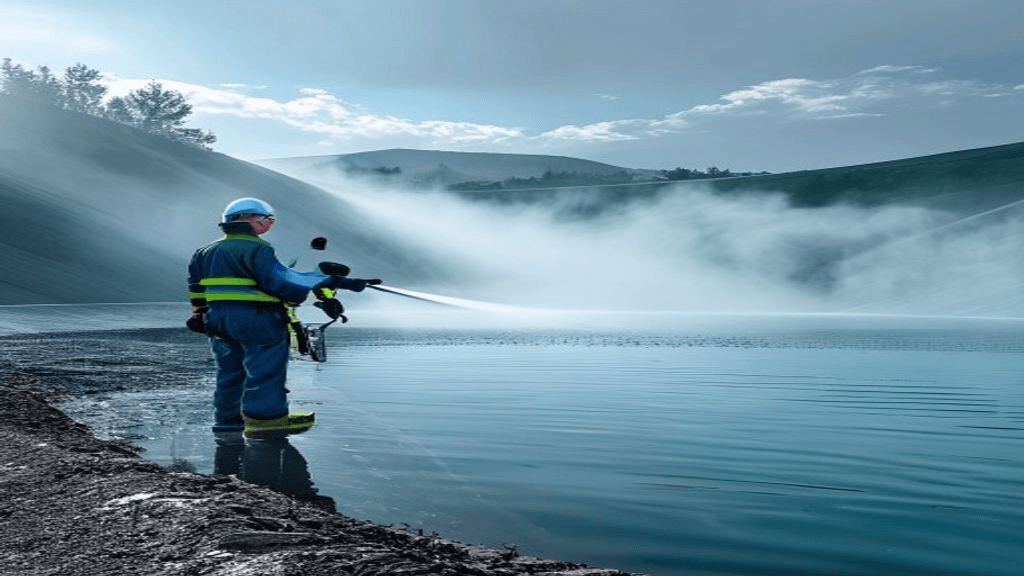
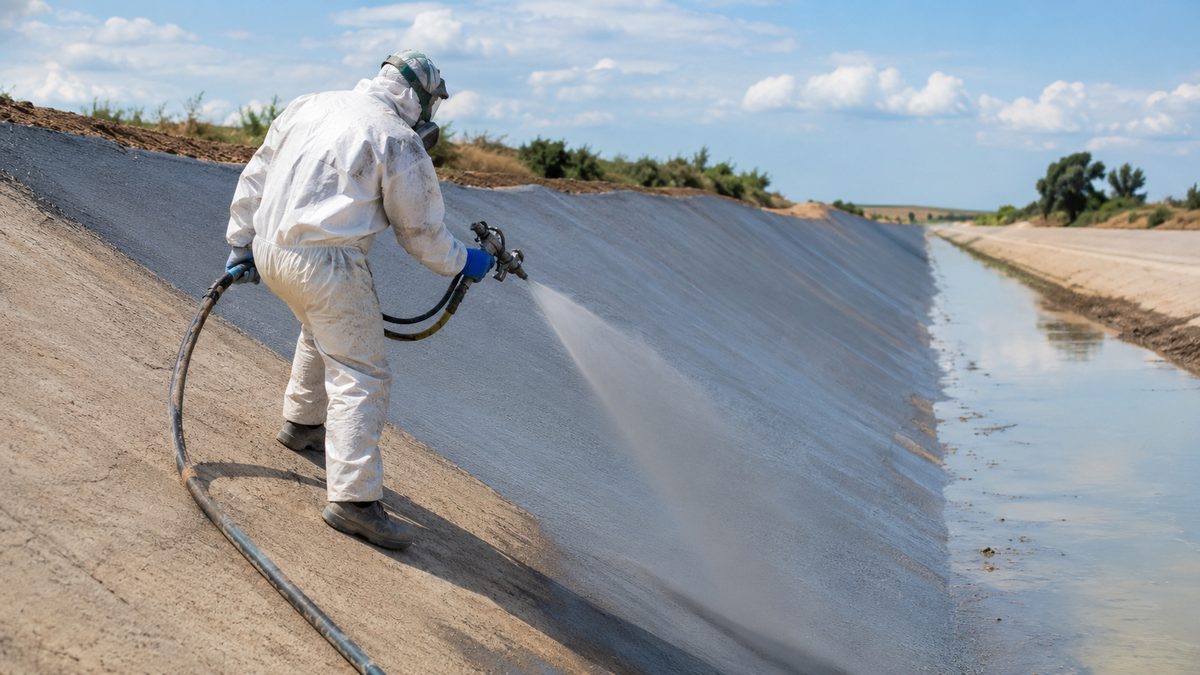
Why polyurea is used for pond and canal lining
Conventional geomembranes — HDPE sheet, PVC liner, EPDM rubber — deliver containment but require extensive seaming, suffer UV degradation at exposed edges, and cannot conform to irregular earthen profiles without folds and wrinkles that become leak paths. Sprayed polyurea eliminates those weaknesses with a liquid-applied film that welds itself to the substrate at the molecular level and is mechanically tested before the water goes in. Per FAO guidance on irrigation water storage, seepage losses from unlined reservoirs routinely exceed 30 to 50 percent of stored volume; a high-quality spray liner closes that gap permanently.
- Seamless monolithic membrane — no welded seams to leak. Because polyurea is sprayed as a reactive liquid, it cures into one continuous skin over the entire pond floor and bank face with zero field seams. There are no laps, welds, or mechanical joints for hydrostatic pressure to pry open, which is the single biggest failure mode of sheet geomembranes at curved banks and irregular corners.
- Sprays over earth, concrete, and geotextile contours. Polyurea bonds directly to compacted and primed earthen banks, existing concrete or shotcrete structures, and geotextile carrier fabrics, following every contour without bridging or folding. This makes it uniquely suited to the irregular banks and sloped sidewalls of earthen ponds and trapezoidal canal sections where sheet liners must be custom-cut and heat-welded on site.
- Fast cure — fill ponds sooner. Pure polyurea gels in seconds and reaches handling strength in minutes. A small basin can be sprayed and filled the same day; a large irrigation reservoir can be filled within 24 hours of the final spray pass, dramatically shortening the lost-service window compared to concrete curing or multi-day epoxy systems.
- Root resistance, UV stability, and crack-bridging elongation. An aliphatic topcoat over an aromatic body coat yields a UV-stable surface that does not chalk or degrade under full solar exposure on open pond banks. The high elongation of polyurea — typically 200 to 400 percent at break — allows the membrane to bridge seasonal soil movement and minor cracking in the substrate without rupturing, which is a critical requirement in climates with significant wet-dry cycling. Roots from bank vegetation cannot penetrate a properly cured polyurea membrane.
Where polyurea pond and canal lining is used
Irrigation Ponds & Farm Reservoirs
Agricultural storage ponds and on-farm irrigation reservoirs are lined with polyurea to eliminate seepage losses that can reach 50 percent of stored volume in sandy or cracked-clay soils. The seamless membrane also prevents bank erosion and keeps water available through dry periods, reducing pumping costs and crop stress.
Drinking-Water Reservoirs
Municipal and rural potable-water reservoirs require a liner material that is chemically inert, non-leaching, and compliant with drinking-water contact standards. Fish-safe and potable-grade polyurea formulations certified for water-contact use seal concrete or earthen walls without introducing plasticizers or solvents into the stored water.
Canals & Water Channels
Lined irrigation and drainage canals reduce conveyance losses and prevent weed and root invasion that clogs unlined earthen channels. Sprayed polyurea follows the trapezoidal cross-section of a canal without seams at the floor-to-bank junction, and its smooth, continuous surface reduces hydraulic friction compared to rough concrete.
Aquaculture Fish & Shrimp Ponds
Indoor and outdoor fish- and shrimp-grow ponds lined with food-safe polyurea allow biosecurity zoning, easy pond-bottom cleaning, and zero seepage that would dilute water-quality management chemicals. A smooth polyurea floor has no pits or seams for pathogen biofilms to colonise, and the membrane does not react with feeds, ammonia, or disinfectants used in intensive aquaculture. See also our shrimp-pond lining project in Vietnam for a real-world application.
Landfill Caps & Secondary Containment Basins
Environmental containment basins for industrial sites, mining tailings ponds, and landfill caps must meet strict leakage standards to satisfy EPA stormwater and containment requirements. Sprayed polyurea over a geotextile carrier delivers a high-tensile, chemical-resistant secondary liner that conforms to complex basin geometry and is field-tested for pinholes before sign-off.
Decorative & Landscape Ponds
Garden ponds, hotel water features, and public landscape water bodies are spray-lined with polyurea over concrete or formed earthen basins to create a permanent, root-impermeable seal that accepts any color topcoat. Unlike EPDM rubber cut-and-fitted over a pond form, a sprayed liner follows the organic shape of a custom pond with zero visible seams.
The application process
Applying a polyurea pond liner is a controlled, two-component spray process. Adhesion to the substrate and long-term containment integrity depend on substrate preparation, machine settings, and systematic spray coverage.
- 1. Substrate preparation and primer. Earthen banks are compacted, graded to a stable slope, and allowed to reach the correct moisture content; loose or saturated soil must be addressed before spraying. Concrete or shotcrete substrates are cleaned to remove laitance, contamination, and standing water, then a compatible penetrating primer is applied and allowed to tack off. For geotextile-over-earth systems, the fabric is pinned flat and sprayed with a bonding coat before the main membrane passes.
- 2. Machine setup. The plural-component machine heats both the isocyanate (A-side) and resin (B-side) to the temperature specified by the polyurea supplier — typically 60 to 70°C — and pressurizes the streams to 25 to 36 MPa to achieve the atomization and impingement mixing that pure polyurea requires. A 1:1 volume ratio is confirmed before spraying begins.
- 3. Spray to target membrane thickness. The liner is built in overlapping passes to a uniform thickness, commonly 40 to 120 mils (approximately 1 to 3 mm) for water-containment liners and 80 to 200 mils (2 to 5 mm) for chemical-containment or high-traffic banks. Extra build-up is added at floor-to-wall junctions and around penetrations such as inlet and outlet pipes.
- 4. Cure, holiday test, and UV topcoat. The polyurea membrane is tack-free in seconds and watertight in minutes. The cured membrane is tested with a holiday detector to locate any pinholes, which are spot-repaired before the basin is filled. On exposed pond banks subject to full sunlight, an aliphatic UV-stable topcoat is applied over the aromatic body coat to prevent surface chalking and maintain membrane integrity over the design life.
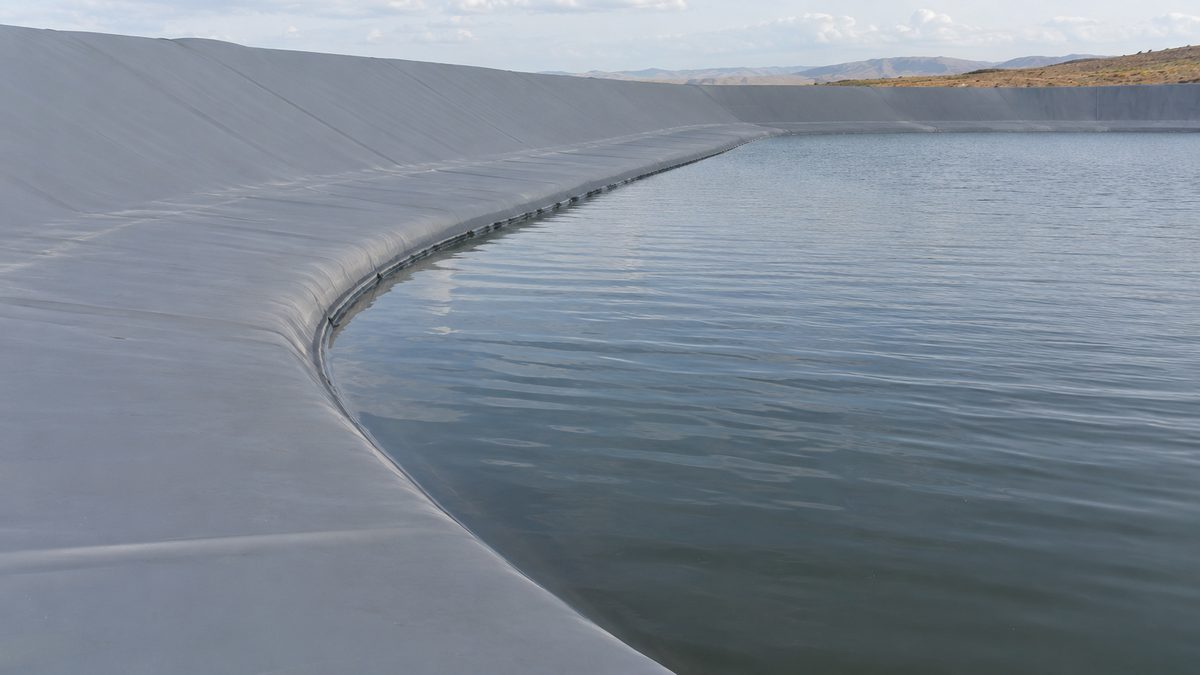
The equipment you need: high-pressure plural-component machines
Pure, fast-set polyurea cannot be applied with a low-pressure roller, brush, or unheated spray kit. It is a 1:1 plural-component material that gels in seconds, so it must be heated to roughly 60 to 70 degrees Celsius and sprayed at 25 to 36 MPa to atomize and impingement-mix the two streams before they react. At those temperatures and pressures, only a purpose-built high-pressure heated machine can deliver the consistent output needed to spray a large pond basin in a single day without cold spots, off-ratio patches, or gun failures.
For large irrigation ponds and canal lining projects where daily output is critical, the hydraulic JYYJ-H-V8T delivers high, sustained flow rate with stable pressure across long hose runs to the bank edge. For mid-size aquaculture basins, containment liners, or decorative ponds where a more compact machine is practical, the electric JYYJ-H600PK and pneumatic JYYJ-H-V6T handle pure polyurea at full pressure with no loss of mix quality. All Pioneer Spray machines include independent temperature control on both sides and digital ratio monitoring so operators can verify that the membrane is going down on-spec before the substrate is committed. See also our guide to polyurea waterproofing for related above-ground applications.
Not sure which JYYJ model fits your pond or canal project — basin size, polyurea supplier, site power supply, or whether a geotextile reinforcement layer is in the spec? Contact our engineers and we will recommend a machine, hose-length, and gun configuration for your containment application.
Frequently Asked Questions
Which Pioneer Spray machine is best for pond and canal lining?
For large irrigation reservoirs and canal projects where daily output matters most, the hydraulic JYYJ-H-V8T is the first choice because of its high sustained flow and stable pressure over long hose runs. For smaller aquaculture ponds, decorative basins, or sites with limited power, the JYYJ-H600PK and the JYYJ-H-V6T both spray pure polyurea at the 25 to 36 MPa required for a pinhole-free containment liner. Our engineers can match the right machine to your basin area, daily production target, and site power supply.
Does the polyurea liner need a geotextile or geomembrane backing on earthen banks?
For compacted, stable earthen banks with a surface primer applied, polyurea can bond directly to the soil without a geotextile carrier. On looser or highly permeable substrates — sandy soils, gravel fill, or steep slopes — spraying over a non-woven geotextile pinned to the bank gives the polyurea a uniform bonding surface and adds puncture resistance from below. Your polyurea supplier and geotechnical engineer will specify whether a carrier fabric is required for your soil conditions.
Can polyurea be used in aquaculture fish or shrimp ponds?
Yes, provided the formulation is certified for fish-safe or potable-water contact. Aromatic polyurea body coats are not certified for direct contact with consumable aquatic species; for aquaculture and drinking-water reservoirs the contractor must use a formulation from the supplier's approved potable-contact product line, confirmed with a certified test report. An aliphatic UV-stable topcoat applied over the body coat also helps maintain the surface for cleaning and biosecurity inspection. Pioneer Spray machines spray both aromatic and aliphatic polyurea chemistries without modification.
How thick should a polyurea pond liner be?
For standard irrigation ponds and decorative water features the minimum membrane thickness is typically 40 to 60 mils (1.0 to 1.5 mm), confirmed by dry-film thickness gauge readings across the basin. Potable and aquaculture reservoirs typically specify 60 to 80 mils (1.5 to 2.0 mm) for margin against accidental puncture during cleaning. Chemical-containment basins and landfill caps commonly call for 80 to 200 mils (2 to 5 mm), and the project specification or environmental permit sets the minimum. All thicknesses are verified by gauge before the basin is signed off and filled.
New to the material? Read our guide to what polyurea lining is, where it is used and the equipment it needs.
Recommended JYYJ Machines
JYYJ-H-V8T
Pioneer's top-tier flagship — the highest-output PLC-controlled spray machine in the JYYJ line. 2-15 kg/min at 36 MPa with 10-inch PLC touchscreen, one-click start/stop operation, and low-temperature protection that prevents incomplete mixing in cold conditions. Flat-mounted booster pump design reduces footprint while maintaining the highest output. Ideal for the most demanding industrial polyurea and polyurethane projects.
JYYJ-H600PK
Adjustable-ratio hydraulic spray machine with 7-inch PLC touchscreen and adjustable mixing ratio (1:1~1:2). 2-10 kg/min at 36 MPa for polyurea, high-density foam, and precision-critical applications. Recipe memory and data logging for project documentation. Adjustable ratio handles temperature-driven viscosity shifts and custom material formulations — unique in the JYYJ line.
JYYJ-H-V6T
Hydraulic workhorse with 7-inch PLC touchscreen control. 2-10 kg/min at 36 MPa, 105 m insulated pipe support, and intelligent automation. Ideal for contractors who need precision control without flagship pricing — the sweet spot between H600 entry and H600PK flagship.
Recommended Materials
Browse Polyurea Coating (A + B) →- ● Fast-set pure polyurea waterproofing membrane (1:1, sprayed at 25-36 MPa, 60-70°C)
- ● Spray-applied polyurea over geotextile or geomembrane reinforcement carrier for earthen banks
- ● Aliphatic UV-stable topcoat for exposed or sunlit pond and canal banks
Why This Setup Works
Seamless monolithic membrane with no welded seams or laps for water to infiltrate
Sprays over earthen banks, concrete, and geotextile contours without folding or bridging
Fast cure allows ponds and canals to be returned to service the same day
Root- and UV-resistant with high elongation that bridges seasonal soil movement and cracking
Technical Considerations
- Substrate prep: compact and prime earthen banks or lay geotextile carrier before spraying
- Typical build 40-120 mils (1-3 mm) for water containment; 80-200 mils (2-5 mm) for chemical or landfill duty
- Pure polyurea requires 1:1 ratio, 60-70°C heated sides, and 25-36 MPa high-pressure spray machine
- Aquaculture and potable-water jobs require a supplier-certified fish-safe or potable-grade formulation plus an aliphatic UV topcoat
Real Projects in Pond, Canal & Geomembrane Lining
Projects for this application are being documented. Share your project requirement and we'll send relevant reference cases.
See Pond, Canal & Geomembrane Lining in Practice
YouTube demonstration videos
@YongjiaPolyurethanemachinepuFrequently Asked Questions
What JYYJ machine is best for pond, canal & geomembrane lining?
Do you supply the raw materials too?
How long is shipping to Russia / LATAM / Middle East?
Do you provide technical training and installation support?
What certifications does the equipment have?
Planning a pond, canal & geomembrane lining project?
Share your output, voltage, and project scale. Pioneer recommends a matched JYYJ machine + material combination within 24 hours.