
Manhole, Sewer & Wastewater Lining
Sprayed pure polyurea protective lining for sanitary manholes, sewer structures, lift stations, and wastewater treatment tanks — seamless, structural-grade.
Polyurea Manhole, Sewer & Wastewater Lining: Equipment and Application Guide
Underground sewer infrastructure faces two relentless enemies: infiltration/inflow (I/I) that overloads treatment plants and misroutes groundwater into the sanitary system, and hydrogen sulfide (H2S) corrosion that dissolves concrete from the inside out. Traditional repair options — cementitious coatings, brick repointing, or full structure replacement — are expensive, slow, and rarely as watertight as a fresh, seamless lining. Sprayed pure polyurea has become the rehabilitation material of choice for municipal and industrial wastewater owners because it bonds to deteriorated concrete, bridges dormant cracks, and cures in seconds, putting structures back in service the same day.
This page explains why polyurea is used for manhole and sewer rehabilitation, where it is applied, and what spray equipment you need. Pioneer Spray builds the high-pressure, heated, plural-component machines that lining contractors depend on for this demanding chemistry, including the hydraulic JYYJ-H-V8T, the JYYJ-H600PK, and the versatile JYYJ-H-V6T. The same heated high-pressure platform is also the basis for polyurea waterproofing and secondary containment lining.
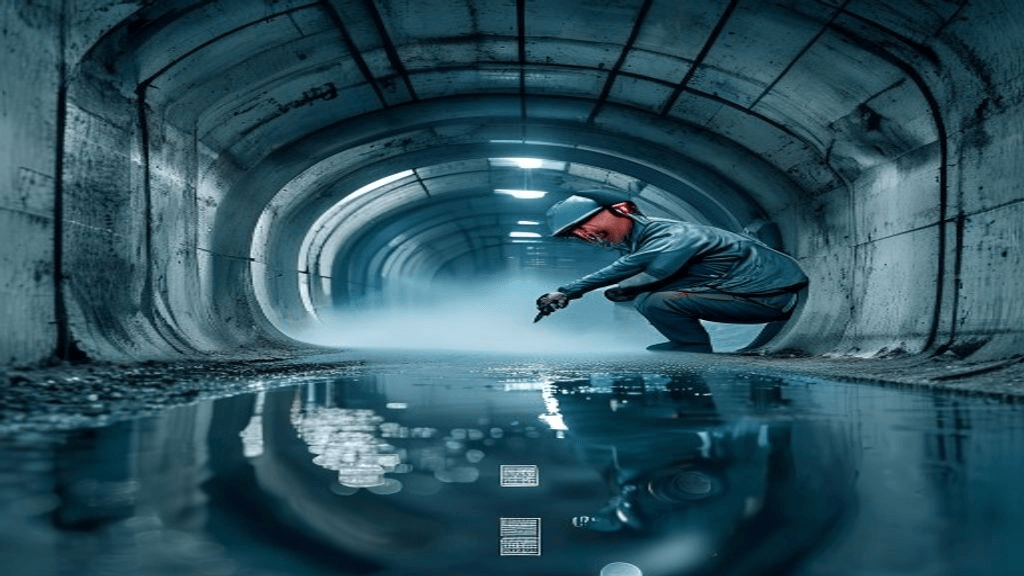
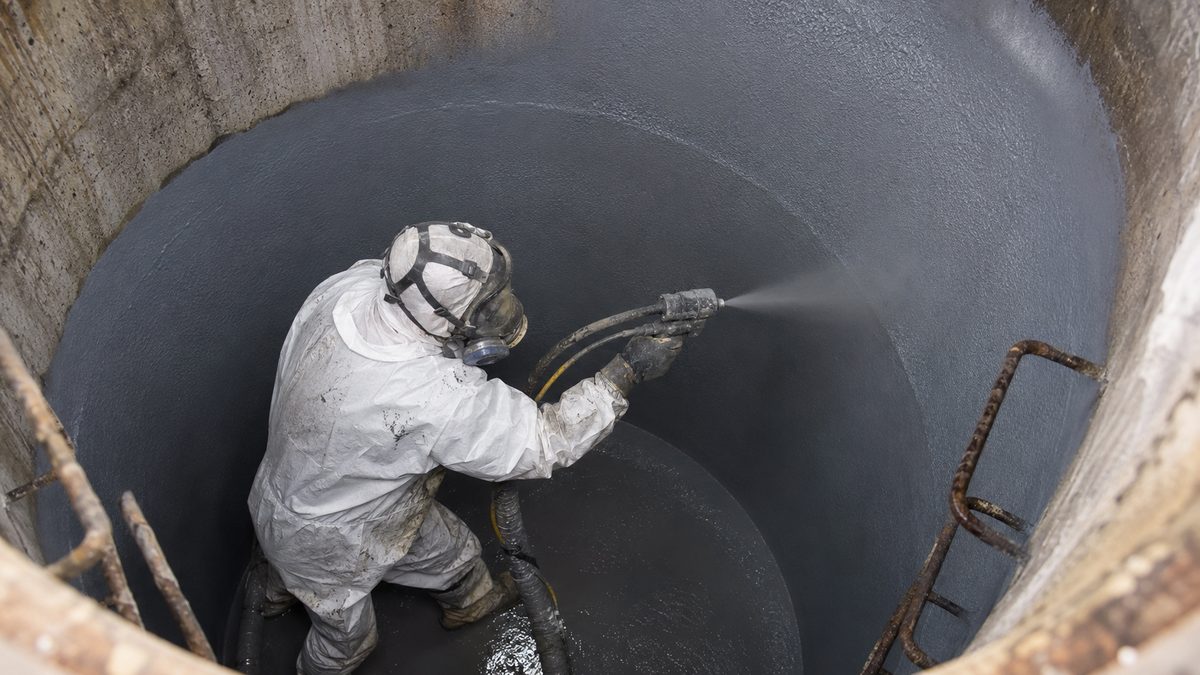
Why polyurea for sewer and wastewater structures
Concrete manholes and sewer structures corrode through a well-documented mechanism: anaerobic bacteria produce H2S gas, which oxidizes to sulfuric acid on moist concrete crowns, dissolving the calcium silicate matrix and creating biological-induced corrosion (MIC). At the same time, groundwater infiltrates through cracks and joints, adding I/I volume that consumes treatment capacity paid for at great expense under the EPA pretreatment program framework. Pure polyurea stops both failure modes with one spray application.
- Seamless monolithic lining stops infiltration/inflow. Sprayed in place as a liquid, polyurea forms a continuous, joint-free membrane that bonds to concrete, brick, and repaired substrate and bridges active hairline cracks. No mortar joint, pipe collar, or liner lap remains for groundwater to exploit.
- Resists H2S and microbial-induced corrosion. A dense, closed polyurea film is chemically inert to the dilute sulfuric acid produced by Thiobacillus bacteria in sewer atmospheres. The concrete underneath stays protected as long as the lining remains intact, stopping the crown corrosion cycle that hollows out untreated manholes in fewer than ten years in aggressive sewer conditions.
- Fast cure — structure back in service same day. Pure polyurea gels in seconds and is hardened for immediate service within minutes, not the hours or days required by cementitious or epoxy coatings. A manhole sprayed in the morning is typically back in service before the crew breaks for lunch, minimizing bypass pumping costs and traffic disruption.
- Rehabilitates deteriorated concrete versus full replacement. Where a manhole wall has lost section to acid corrosion, polyurea bonds over the repaired, profiled surface and restores structural continuity at a fraction of the cost and carbon footprint of excavating and replacing the structure. This aligns with the rehabilitation-first approach advocated by the EPA decentralized wastewater guidance for aging collection systems.
Where it is used
Sanitary Manholes
Sanitary manholes are the most common application for polyurea sewer lining. A sprayed pure polyurea coat seals the cone, barrel, and bench, bridging crack networks, covering pipe-to-wall transitions, and stopping the groundwater infiltration that overloads downstream treatment capacity.
Sewer Pipes & Junction Structures
Large-diameter sewer barrels, junction chambers, and drop structures are spray-lined with polyurea to restore water tightness and protect concrete from continued H2S attack. Entry crews work from inside; the fast gel time keeps each section contained and back in service rapidly.
Lift Stations & Wet Wells
Lift station wet wells concentrate H2S at the liquid surface and in the vapor space above it, accelerating crown corrosion and joint deterioration. A seamless polyurea coat isolates all concrete and mortar surfaces from the corrosive sewer atmosphere, protecting the structure for years without recoating.
Wastewater Treatment Tanks & Clarifiers
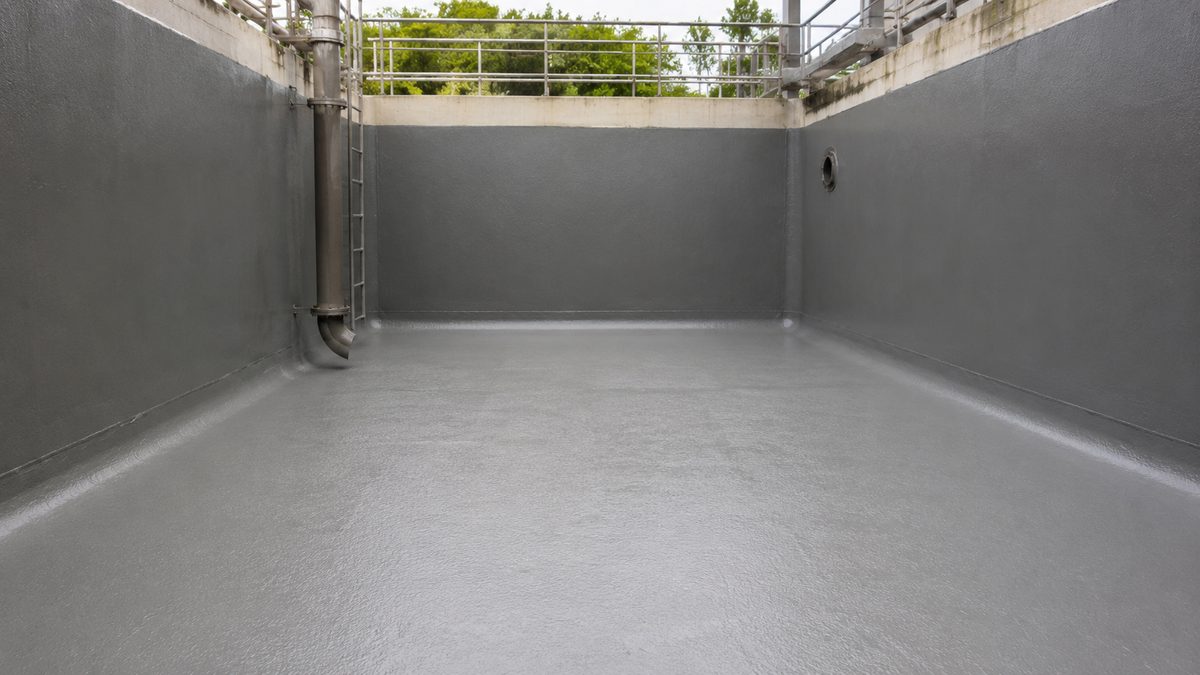
Primary clarifiers, aeration basins, and digester walls are sprayed with chemical-resistant polyurea to block leakage, protect concrete from process chemicals, and maintain the structural integrity of tanks that cannot easily be taken out of service for cement-based repairs.
Pump Stations & Valve Chambers
Pump station sumps, valve vaults, and wet side chambers are difficult to waterproof with rigid materials because of the complex geometry of penetrations, brackets, and flanges. Polyurea is sprayed as a liquid, sealing around every intrusion point in a single continuous coat.
Stormwater & Culvert Structures
Stormwater manholes, culvert end sections, and headwall structures are lined with polyurea to stop infiltration and protect concrete from freeze-thaw cycling, root intrusion, and the abrasion of debris-laden stormwater flows that scour unprotected inlet faces.
The application process
Spraying polyurea lining in a confined sewer or manhole structure is a controlled, safety-managed operation. Adhesion and long-term water tightness depend on proper substrate preparation, bypass of live flow, and accurate machine settings.
- 1. Bypass pumping, cleaning, and concrete repair. Live flow is diverted with bypass pumping before entry. The structure interior is cleaned by high-pressure water jetting to remove grease, biofilm, and loose concrete. Severely corroded areas are rebuilt with rapid-set cementitious mortar and allowed to cure to the degree required by the polyurea supplier before spray application begins. Pipe penetrations and active leaks are plugged or grouted.
- 2. Substrate drying, priming, and profile check. Concrete moisture content is verified — most pure polyurea suppliers specify surface dry or a maximum moisture tolerance. A compatible penetrating primer is applied to concrete and cured mortar surfaces, ensuring the polyurea bonds to the substrate rather than to surface moisture. Substrate profile and smoothness are confirmed to avoid holidays over sharp aggregate.
- 3. Machine setup and spray to target build. The plural-component machine heats both the isocyanate and resin sides to the supplier-recommended temperature (typically 60–70 °C) and maintains pressure in the 25–36 MPa range for correct atomization and impingement mixing at the spray gun. Polyurea is sprayed in controlled passes to build the specified lining thickness, typically 60–125 mils (about 1.5–3 mm) for manhole rehabilitation, with care taken to coat all bench, invert, and cone surfaces uniformly.
- 4. Cure, holiday test, and return to service. The polyurea film is tack-free in seconds and reaches full service hardness within minutes. Contractors perform a holiday (spark) test on the completed lining to detect pinholes, repair any defects with a hand-applied patch, and verify dry-film thickness with a gauge before pulling the bypass and returning the structure to service — often the same work day.
The equipment you need
Pure polyurea for manhole and sewer lining cannot be applied with low-pressure or unheated equipment. It is a 1:1 plural-component material that gels in seconds, which means it must be heated to roughly 60–70 °C and pumped at high pressure so the two streams collide, mix, and atomize inside an impingement-mix gun before contacting the substrate. Pioneer Spray machines operate in the 25–36 MPa range that this chemistry demands. The hydraulic JYYJ-H-V8T delivers high output for large-diameter sewer structures and wet-well barrel lining, while the JYYJ-H600PK is a compact, field-deployable unit suited to the confined-access and variable-power conditions common on municipal manhole rehabilitation projects.
Low-pressure foam kits, moisture-cure coatings, and cartridge-dispensed urethanes cannot heat and pressurize a fast-set polyurea to the parameters this chemistry requires. The result is incomplete mixing, soft or tacky areas, and a lining that disbonds under hydrostatic groundwater pressure — exactly the failure mode that forces a second mobilization. For confined-space manhole work where access is limited and downtime is measured in hours, getting the chemistry right the first time with a properly configured machine is not optional.
Not sure which JYYJ model fits your sewer rehabilitation fleet, your polyurea supplier's specifications, or your generator power capacity on site? Contact our engineers and we will size a machine, hose package, and gun configuration for your manhole and sewer lining program. The JYYJ-H-V6T is also worth evaluating for mid-volume sewer contractors who need a balance of output and portability.
Frequently Asked Questions
Which Pioneer Spray machine is best for manhole and sewer lining?
For most municipal manhole rehabilitation and wet-well lining, the JYYJ-H600PK is a practical choice because of its compact footprint and adaptability to generator power at confined-space jobsites. For larger-diameter sewer structures or high-volume production work, the hydraulic JYYJ-H-V8T provides higher output and rock-stable pressure at thick build rates. The JYYJ-H-V6T suits mid-volume sewer contractors who need a balance of machine size and daily throughput.
Can polyurea lining be applied over active wet concrete?
Most fast-set pure polyurea formulations tolerate surface-dry concrete but require the substrate to meet the moisture threshold specified by the material supplier — typically verified with a surface moisture meter before priming. Active groundwater seeps and leaking pipe penetrations must be grouted or plugged before application; a primer coat then bridges the transition. Spraying directly onto standing water or a dripping surface will cause disbondment regardless of machine settings.
How thick should the polyurea lining be in a manhole?
Manhole rehabilitation specifications typically call for 60–125 mils (about 1.5–3 mm) of pure polyurea, with the exact build driven by the degree of concrete deterioration, the design groundwater head, and the project specification. Structural rehabilitation of severely corroded barrel walls may call for a higher build, while new-construction waterproofing of sound concrete manholes may be specified at the lower end of that range. Dry-film thickness is verified with a gauge after application.
How long before the manhole can return to service after polyurea lining?
Pure polyurea is tack-free in seconds and hardened enough to pull the bypass and restore flow within minutes of completing the spray application — typically the same work shift. This contrasts sharply with cementitious liners that require 24–72 hours of cure before service loading, making polyurea especially valuable where bypass pumping costs or traffic management fees accumulate by the hour.
New to the material? Read our guide to what polyurea lining is, where it is used and the equipment it needs.
Recommended JYYJ Machines
JYYJ-H-V8T
Pioneer's top-tier flagship — the highest-output PLC-controlled spray machine in the JYYJ line. 2-15 kg/min at 36 MPa with 10-inch PLC touchscreen, one-click start/stop operation, and low-temperature protection that prevents incomplete mixing in cold conditions. Flat-mounted booster pump design reduces footprint while maintaining the highest output. Ideal for the most demanding industrial polyurea and polyurethane projects.
JYYJ-H600PK
Adjustable-ratio hydraulic spray machine with 7-inch PLC touchscreen and adjustable mixing ratio (1:1~1:2). 2-10 kg/min at 36 MPa for polyurea, high-density foam, and precision-critical applications. Recipe memory and data logging for project documentation. Adjustable ratio handles temperature-driven viscosity shifts and custom material formulations — unique in the JYYJ line.
JYYJ-H-V6T
Hydraulic workhorse with 7-inch PLC touchscreen control. 2-10 kg/min at 36 MPa, 105 m insulated pipe support, and intelligent automation. Ideal for contractors who need precision control without flagship pricing — the sweet spot between H600 entry and H600PK flagship.
Recommended Materials
Browse Polyurea Coating (A + B) →- ● Fast-set pure polyurea for manhole and sewer rehabilitation (1:1, gels in seconds)
- ● High-build structural polyurea over repaired concrete for section-loss restoration
- ● Chemical- and H2S-resistant polyurea for corrosive sewer and wastewater atmospheres
Why This Setup Works
Seamless monolithic lining stops infiltration/inflow — no joints or laps for groundwater to exploit
Resists H2S and microbial-induced corrosion in sewer atmospheres
Fast cure returns structure to service same day, minimizing bypass pumping cost
Rehabilitates deteriorated concrete at a fraction of the cost of full replacement
Technical Considerations
- Bypass pumping, flow control, cleaning, and concrete repair required before lining
- Substrate moisture and surface profile must meet polyurea supplier specifications before priming
- Typical build 60–125 mils (1.5–3 mm); structural rehab sections may require greater thickness
- Pure polyurea requires 1:1 ratio, 60–70 °C heat, and 25–36 MPa high-pressure heated machine
Real Projects in Manhole, Sewer & Wastewater Lining
Projects for this application are being documented. Share your project requirement and we'll send relevant reference cases.
See Manhole, Sewer & Wastewater Lining in Practice
YouTube demonstration videos
@YongjiaPolyurethanemachinepuFrequently Asked Questions
What JYYJ machine is best for manhole, sewer & wastewater lining?
Do you supply the raw materials too?
How long is shipping to Russia / LATAM / Middle East?
Do you provide technical training and installation support?
What certifications does the equipment have?
Planning a manhole, sewer & wastewater lining project?
Share your output, voltage, and project scale. Pioneer recommends a matched JYYJ machine + material combination within 24 hours.