
Concrete Lifting Equipment & Slab Jacking Foam
Concrete lifting & leveling equipment: high-density polyurethane foam raises settled slabs through small ports — Pioneer JYYJ slab-jacking rigs, faster than mudjacking.
Concrete Lifting & Leveling with High-Density Polyurethane Geotechnical Foam
Settled, sunken, or uneven concrete slabs are a safety hazard, a drainage problem, and a costly liability. Whether the affected surface is a residential driveway, a warehouse floor, a highway pavement panel, or an airport apron, the traditional remedies — mudjacking with cement-soil grout or full slab replacement — mean long downtime, heavy equipment, and significant cost. High-density structural polyurethane geotechnical foam offers a faster, cleaner, and less disruptive alternative: crews drill small ports through the slab, inject two-component expanding foam underneath, monitor the lift with a laser level, and patch the ports. The slab is typically traffic-ready within an hour.
This page explains why high-density polyurethane geotechnical foam has become the preferred material for concrete lifting, where it is applied, and what equipment you need to inject it. Pioneer Spray builds the high-pressure, heated, plural-component machines that foam-lifting contractors use for controlled, repeatable injection, including the JYYJ-H-V8T, the JYYJ-H600PK, and the JYYJ-H600. See also our concrete-lifting equipment guide for a deeper dive into machine selection.
Why polyurethane foam for concrete lifting
High-density structural polyurethane geotechnical foam wins the comparison against mudjacking grout and slab replacement on nearly every practical dimension.
- Fast rise and rapid return to service. Two-component expanding foam begins to rise within seconds of injection and reaches most of its compressive strength within minutes, not hours. A residential driveway panel or a warehouse floor aisle is typically open to foot traffic and light vehicles the same day, whereas cementitious mudjacking grout requires curing time and slab replacement can close a lane for days.
- Lightweight — minimal added load to subgrade. High-density structural lifting foam weighs roughly 4–6 lb/ft³ (64–96 kg/m³), a fraction of the weight of the cement-soil grout used in mudjacking. Adding mass over already-weak, water-saturated, or expansive subgrade can worsen the settlement problem; foam adds negligible load while filling voids and building compressive support.
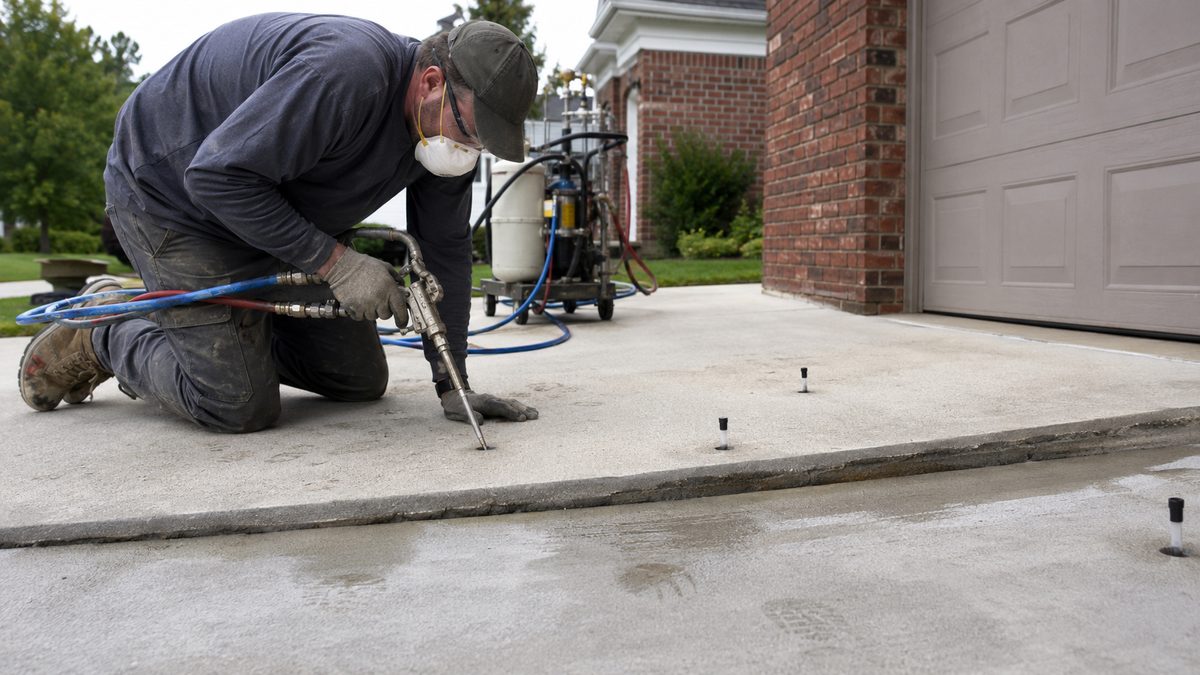
- Minimally invasive small drilled ports. Injection requires only ports drilled at 16–25 mm diameter, through which the gun tip is inserted. No excavation, no lifting cranes, no demolition. The slab itself remains in place and intact, and the ports are patched after the lift so the surface is visually clean.
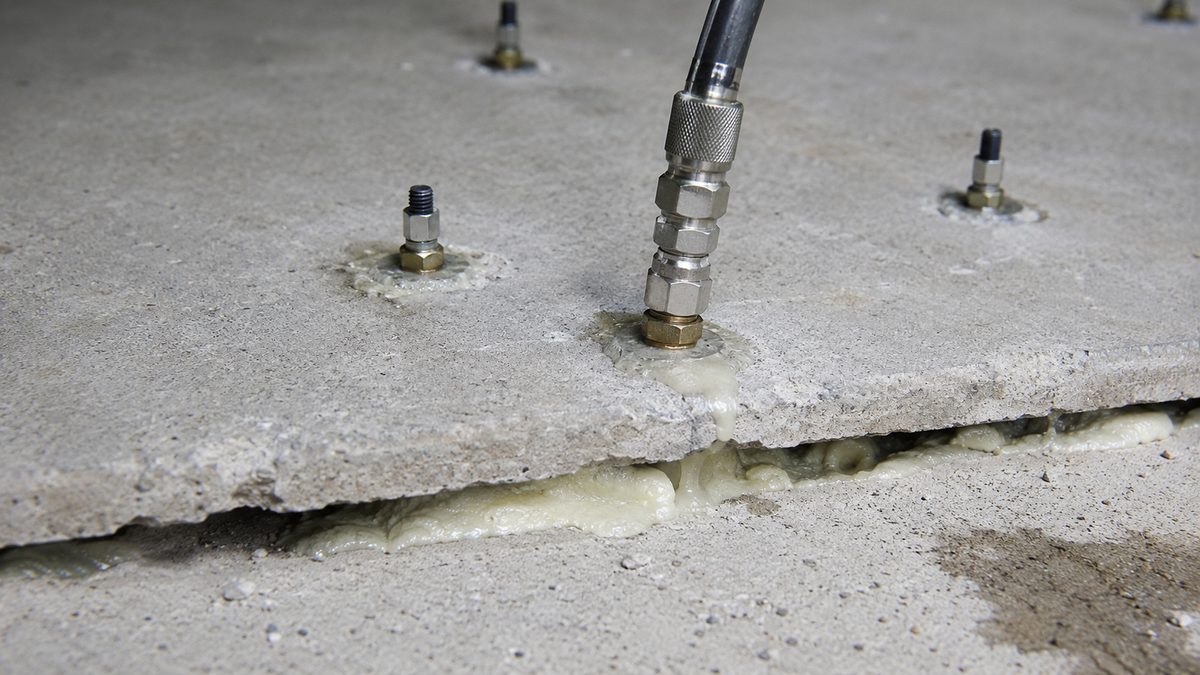
- Void filling and subgrade stabilization. Expanding foam does not just lift the slab — it fills air pockets, erosion voids, and water channels under the concrete, encapsulating loose material and preventing future migration of fines. Mudjacking grout does not expand, so it can bridge a void without fully filling it.
- Hydro-insensitive formulations for wet or saturated conditions. Specialized geotechnical foam grades are formulated to react and expand even in the presence of water or saturated soil, sealing active infiltration as they cure. Conventional grout injection into wet voids can be washed out before it sets. See the FHWA concrete pavement guidance for recognized stabilization methods and the ASTM D1621 foam compressive strength standard for material qualification.
Where concrete lifting foam is used
Residential Slabs & Driveways
Settled driveway panels, garage aprons, front stoops, pool decks, and patio slabs are classic foam-jacking applications. Small ports are nearly invisible after patching, and the lift is complete before the homeowner finishes a cup of coffee.
Warehouse & Industrial Floors
Floor slabs in logistics centers, manufacturing plants, and cold-storage facilities must be level for forklift operation, racking stability, and OSHA compliance. Foam injection lifts settled panels with minimal disruption to operations, often during a planned off-shift.
Highway & Pavement Slab Stabilization
Faulted or voided highway concrete panels create rough ride, edge cracking, and blowup risk. Foam injection under pavement slabs fills voids, re-supports the slab, and restores slab-to-slab load transfer without full-depth repair or lane closure measured in days.
Void Filling Under Slabs & Infrastructure
Erosion, utility breaks, and underground water migration create voids beneath slabs, bridge approach panels, and buried structures. Expanding geotechnical foam fills these voids completely, arresting progressive settlement before visible cracking begins.
Foundation & Settlement Repair
Shallow foundation slabs, garage floors, and basement slabs that have settled due to soil consolidation or moisture change can be raised and releveled with foam. The approach complements piering for differential settlement where the slab itself needs releveling after the foundation is stabilized.
Airport, Port & Heavy-Load Slabs
Airport aprons, container yard slabs, and port terminal pavements carry extreme wheel loads. High-density geotechnical foam meeting appropriate compressive strength requirements supports these loads while allowing rapid return to aircraft or heavy equipment operation.
The lifting process
Concrete lifting with polyurethane geotechnical foam is a four-step process that a trained two-person crew can execute efficiently with a properly configured plural-component machine.
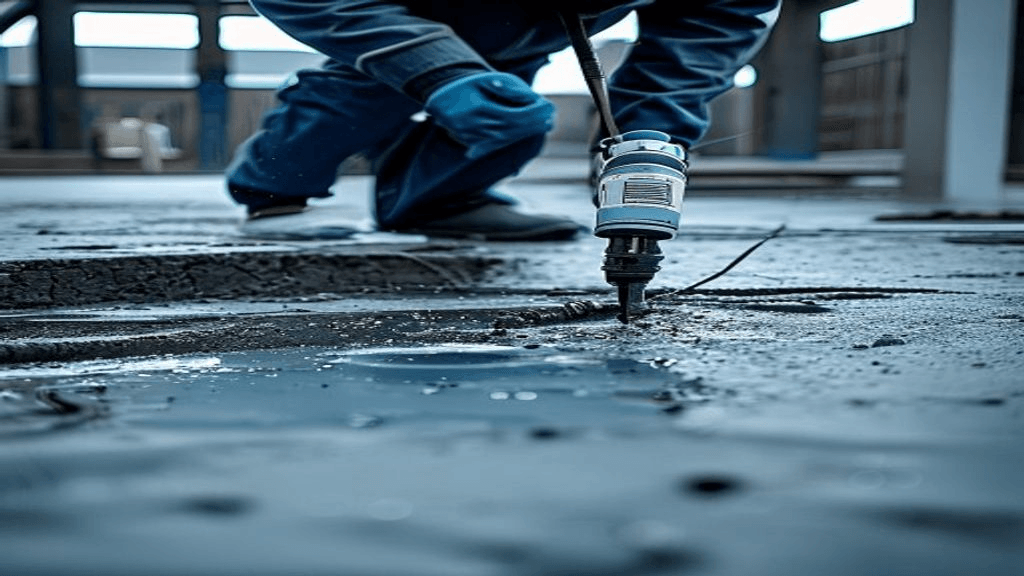
- 1. Drill injection ports. Ports are laid out in a pattern calculated to distribute lift evenly across the slab panel — typically a grid starting near the low corner and working toward the high side. Port diameter is usually 16–25 mm, small enough to patch invisibly.
- 2. Inject expanding foam and monitor lift. The foam gun is inserted into the port and the machine delivers the two components — isocyanate and polyol resin — at the correct 1:1 ratio, temperature, and pressure. Foam expands under the slab, filling voids and beginning to lift. A laser level or dial indicator on the slab surface gives the operator real-time feedback on lift rate and amount.
- 3. Monitor and stop at target elevation. Injection is performed in short bursts, checking the level between each burst, until the slab reaches the target grade. Working from port to port in the right sequence prevents cracking the slab by lifting one end faster than the other.
- 4. Patch ports and return to service. Once the lift is complete and the foam has cured, the injection ports are filled with a cement or epoxy patch. The surface is clean within minutes, and the slab is typically open to traffic the same day — far sooner than mudjacking or replacement.
The equipment you need
High-density polyurethane geotechnical foam is a two-component, 1:1 ratio material that requires a plural-component machine to heat, pressurize, and meter both components simultaneously. Accurate ratio control is critical: an off-ratio mix produces foam with lower density, reduced compressive strength, and unpredictable expansion — all unacceptable when lifting concrete under load. Pioneer Spray machines are designed to hold precise ratio and stable pressure throughout the injection cycle, operating in the 25–36 MPa range that geotechnical foam chemistry requires.
The hydraulic JYYJ-H-V8T is well-suited to high-volume highway and industrial slab stabilization projects where consistent output across many ports and long hose runs is required. The JYYJ-H600PK is a popular choice for mid-scale commercial and municipal slab-lifting contractors who need a reliable machine that can be transported easily between sites. The JYYJ-H600 suits lighter-duty and residential foam-lifting work where compact size and lower daily output are priorities. All three models maintain the temperature and pressure that geotechnical foam formulations demand for proper expansion and compressive strength development.
Not sure which machine fits your foam-lifting workload, your material supplier's specifications, or your crew size? Contact our engineers and we will recommend a machine, hose length, and gun configuration for your concrete-lifting application. You may also want to explore our spray foam insulation application page if your work spans both insulation and geotechnical foam injection.
Frequently Asked Questions
What density of polyurethane foam is used for concrete lifting?
Standard residential and commercial slab-jacking typically uses foam in the 4–6 lb/ft³ (64–96 kg/m³) density class, which provides adequate compressive strength for most applications while keeping added weight low. Heavy-load applications such as highway pavement panels and airport aprons may specify higher-density foam to meet the compressive strength requirements of the governing standard, qualified to ASTM D1621 foam compressive strength. Your material supplier and geotechnical engineer determine the correct density for each project.
How long before the concrete is back in service after foam injection?
High-density polyurethane geotechnical foam reaches most of its working compressive strength within minutes of injection. Most residential and light-commercial slabs are open to foot traffic immediately and to vehicles within an hour or two. Heavy-load pavements may be returned to traffic the same day. This is one of the key advantages over mudjacking grout, which typically requires several hours of curing before loading.
Can any Pioneer Spray machine inject geotechnical lifting foam?
Yes, provided the machine can heat both components to the temperature and maintain the pressure that the specific foam formulation requires. The JYYJ-H-V8T, JYYJ-H600PK, and JYYJ-H600 are all capable platforms for geotechnical foam injection, covering the range from residential lifting to large pavement stabilization. We configure the machine settings to match your foam supplier's technical data sheet for temperature, pressure, and ratio. Contact us to confirm the right model for your application volume.
Does foam injection fix the cause of settlement?
No. High-density structural polyurethane geotechnical foam lifts and stabilizes the slab and fills the voids that allowed movement, but it does not correct the underlying cause of settlement — poor compaction, utility leaks, erosive subgrade, or expansive soils. Diagnosing and addressing the root cause is essential before or alongside injection, or the slab may re-settle over time. A geotechnical investigation is always recommended for recurring or large-scale settlement.
Recommended JYYJ Machines
JYYJ-H-V8T
Pioneer's top-tier flagship — the highest-output PLC-controlled spray machine in the JYYJ line. 2-15 kg/min at 36 MPa with 10-inch PLC touchscreen, one-click start/stop operation, and low-temperature protection that prevents incomplete mixing in cold conditions. Flat-mounted booster pump design reduces footprint while maintaining the highest output. Ideal for the most demanding industrial polyurea and polyurethane projects.
JYYJ-H600PK
Adjustable-ratio hydraulic spray machine with 7-inch PLC touchscreen and adjustable mixing ratio (1:1~1:2). 2-10 kg/min at 36 MPa for polyurea, high-density foam, and precision-critical applications. Recipe memory and data logging for project documentation. Adjustable ratio handles temperature-driven viscosity shifts and custom material formulations — unique in the JYYJ line.
JYYJ-H600
Entry-level hydraulic spray machine — the gateway to professional-grade pressure. 2-12 kg/min at 36 MPa with 6-18 MPa hydraulic system pressure. Compatible with both polyurethane foam and polyurea coatings. Air-cooling system protects motor and pump for sustained heavy-duty operation.
Recommended Materials
Browse Polyurethane Foam (A + B) →- ● High-density structural polyurethane lifting foam (typically 4–6 lb/ft³ class) for residential driveways, commercial floors, and standard slab-jacking
- ● Higher-density geotechnical foam for heavy-load applications such as highway pavement panels, airport aprons, and port terminal slabs
- ● Hydro-insensitive geotechnical foam formulated to expand in wet or water-saturated voids, sealing active infiltration as it cures
Why This Setup Works
Lifts and levels concrete in minutes with fast-rise expanding foam — slab typically traffic-ready the same day
Lightweight foam adds minimal load to the subgrade versus heavy cementitious mudjacking grout
Minimally invasive 16–25 mm drilled ports — no excavation, no demolition, patchable to near-invisible
Cures fast and fills voids completely, stabilizing loose subgrade and preventing future fine migration
Technical Considerations
- Foam density selected to match the load and lift requirement of the specific slab application
- Drill-port layout and injection sequence must distribute lift evenly to avoid cracking the slab
- Plural-component machine must hold accurate 1:1 ratio, correct heat, and 25–36 MPa high pressure for proper foam rise and compressive strength
- Foam injection is not a structural-cause fix — diagnose and address the settlement source before or alongside injection
Real Projects in Concrete Lifting Equipment & Slab Jacking Foam
Projects for this application are being documented. Share your project requirement and we'll send relevant reference cases.
See Concrete Lifting Equipment & Slab Jacking Foam in Practice
YouTube demonstration videos
@YongjiaPolyurethanemachinepuFrequently Asked Questions
What JYYJ machine is best for concrete lifting equipment & slab jacking foam?
Do you supply the raw materials too?
How long is shipping to Russia / LATAM / Middle East?
Do you provide technical training and installation support?
What certifications does the equipment have?
Planning a concrete lifting equipment & slab jacking foam project?
Share your output, voltage, and project scale. Pioneer recommends a matched JYYJ machine + material combination within 24 hours.