
Secondary Containment & Chemical-Resistant Lining
Sprayed pure polyurea lining for containment bunds, dikes, spill basins, fuel-farm berms, chemical process floors, trenches, and sumps — a seamless.
Secondary Containment & Chemical-Resistant Lining: Equipment and Application Guide
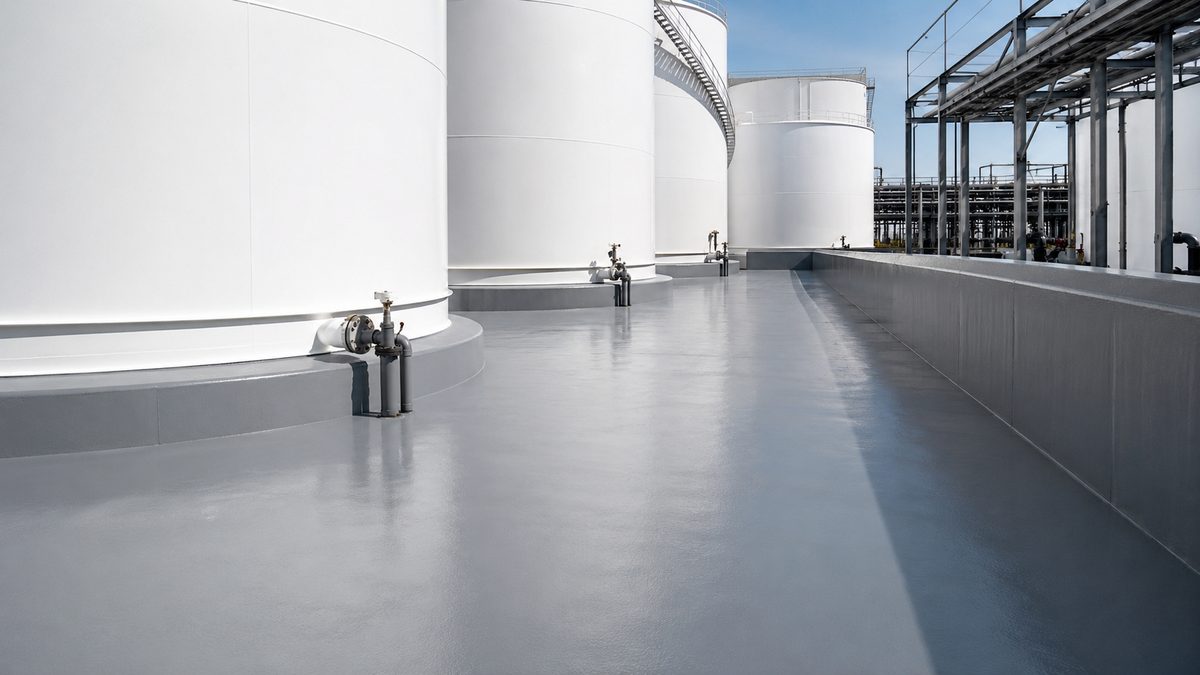
A containment bund or spill basin exists for one purpose: to hold a worst-case release of stored product long enough for a response team to act. That function depends entirely on the integrity of the liner. Cracks, construction joints, porous concrete, and corroded steel are all pathways to soil and groundwater contamination — and to regulatory liability under frameworks such as the EPA SPCC secondary containment regulations. Sprayed pure polyurea solves every one of those failure modes in a single application: it is seamless, crack-bridging, chemically resistant, and cures in minutes so that facilities stay in service.
This page explains why polyurea has become the lining of choice for secondary containment, where it is used, and what spray equipment is required. Pioneer Spray manufactures the high-pressure, heated, plural-component machines that industrial coating contractors rely on to apply fast-set polyurea correctly, including the heavy hydraulic JYYJ-H-V8T. For related tank lining work, see our tank lining application page.
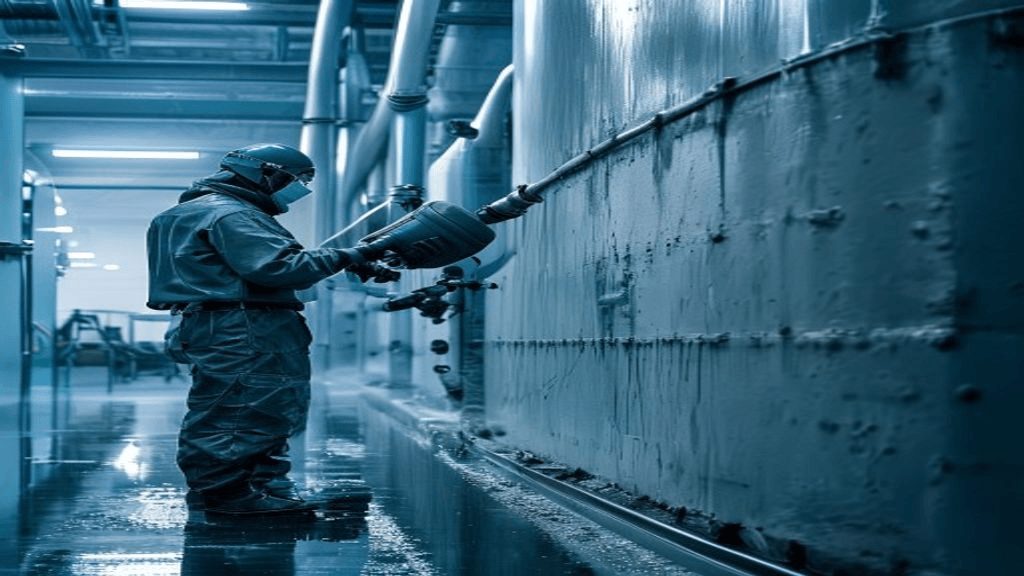
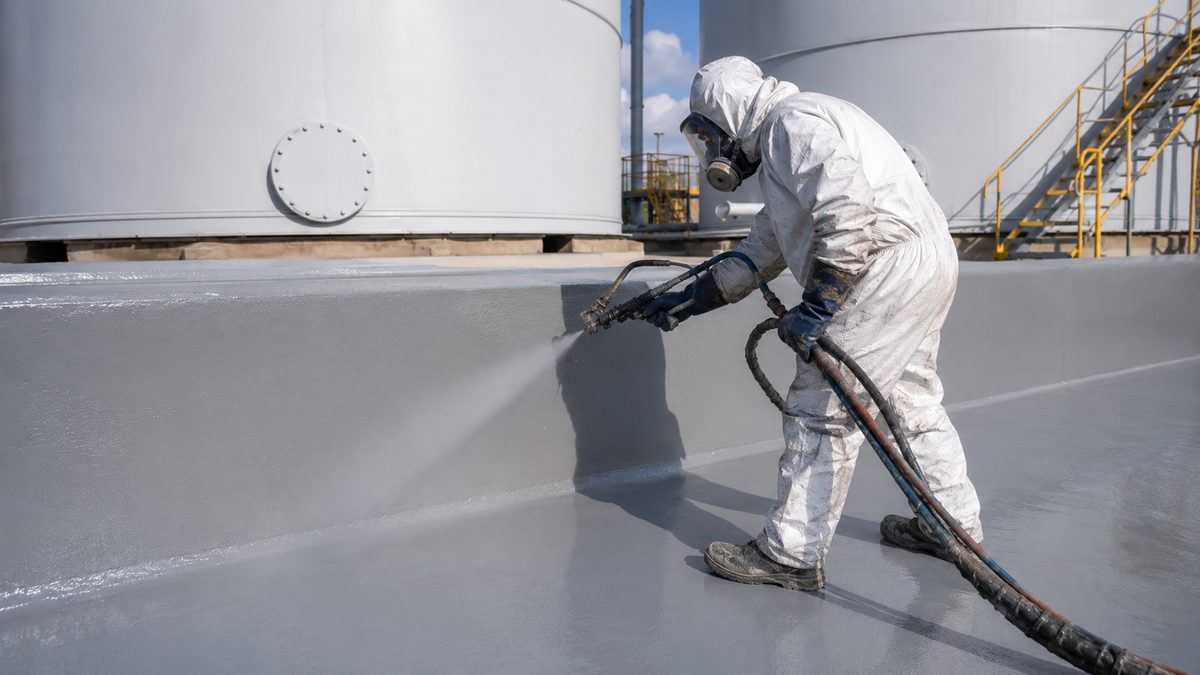
Why polyurea is the standard for secondary containment lining
Concrete bunds crack. Steel dike floors corrode. Bituminous coatings swell in hydrocarbon contact and crack in UV. Pure polyurea eliminates all three failure mechanisms with a single-application elastomeric membrane that outperforms every legacy containment liner across the conditions that matter in an operating plant.
- Seamless monolithic membrane — no escape pathways. Polyurea is sprayed as a liquid and cures in place as one continuous film with no construction joints, seams, or laps for aggressive chemicals to migrate through. Any joint is a future failure point; a sprayed coat has none.
- Crack-bridging over concrete movement. Concrete containment structures shrink, settle, and thermally cycle, opening hairline to moderate cracks over time. A properly specified pure polyurea membrane, with its combination of high tensile strength and high elongation, bridges those cracks and maintains the liquid seal even as the substrate moves beneath it.
- Broad chemical and hydrocarbon resistance. Pure polyurea formulations are resistant to fuels, oils, many acids and alkalis, brine, and a wide range of industrial process chemicals. Specialty chemical-resistant grades extend compatibility further. Applicators confirm resistance with the polyurea supplier's chemical-compatibility data for the specific stored medium before specifying a product.
- UV and weathering stability. Aliphatic or aliphatic-capped polyurea topcoats maintain color and surface integrity under continuous outdoor UV exposure, keeping the containment surface intact and inspectable for the life of the facility.
- Fast cure — minimal facility downtime. Pure polyurea is tack-free in seconds and return-to-service ready within minutes. A lined bund can be inspected, back-filled, and returned to service the same day, compared to days or weeks for cementitious or epoxy coatings that must cure before chemical exposure. This fast cure also supports compliance schedules when a facility must demonstrate containment integrity within a regulatory deadline. See OSHA isocyanate safety guidance for proper respiratory and skin protection protocols during application.
Where polyurea secondary containment lining is used
Fuel & Oil Farm Bunds
Above-ground storage tank bunds at petroleum terminals, fuel farms, and oil distribution depots are lined with polyurea to contain a full tank release, resist hydrocarbon permeation, and satisfy SPCC and local fire-code bund impermeability requirements.
Chemical Storage Containment
Containment areas for drums, totes, and bulk chemical tanks at manufacturing, blending, and distribution facilities are lined with chemical-resistant polyurea to hold aggressive liquids and prevent soil and groundwater contamination in the event of a release.
Process Plant Floors & Trenches
Chemical process floors, drainage trenches, and collection sumps in refineries, petrochemical plants, and industrial facilities are coated with polyurea to contain incidental spills, resist chemical attack on the concrete structure, and maintain a cleanable, impermeable surface.
Spill-Containment Basins & Sumps
Emergency spill basins, interceptor pits, and collection sumps downstream of process areas or loading racks are lined with polyurea to handle unpredictable chemical mixes and provide a durable, long-service sump that does not need frequent recoating.
Loading & Unloading Bays
Truck and railcar loading and unloading pads, drip pans, and transfer areas where product spills are routine are lined with seamless polyurea that drains to collection points without infiltrating the concrete pad or the soil below.
Water-Treatment & Wastewater Structures
Retention basins, equalization tanks, secondary clarifiers, and digesters in water and wastewater treatment plants are coated with polyurea to resist aggressive biological and chemical environments while providing a crack-bridging liner that survives the structural movement of large concrete vessels.
The secondary containment lining application process
Applying polyurea to a containment structure is a controlled, four-step sequence. Every step matters: a missed crack, an under-primed substrate, or an off-ratio spray pass can compromise the barrier that the whole system depends on.
- 1. Concrete preparation — blast, profile, and moisture control. Concrete substrates are abrasive-blasted or shot-blasted to an open profile (typically CSP 3 to 5) to remove laitance, curing compounds, contamination, and weak surface layers. Cracks wider than hairline are routed and filled with a compatible sealant or epoxy mortar before lining. Concrete must be dry to below the polyurea supplier's moisture threshold and at least 3 to 4 °C above dew point to prevent blistering.
- 2. Prime the substrate. A moisture-tolerant, penetrating epoxy or polyurethane primer is applied to the prepared concrete and allowed to cure to a tacky state. Primer is critical in secondary containment because it bonds the elastic polyurea membrane to the concrete and prevents hydrostatic disbondment if the liner is ever exposed to water pressure from below.
- 3. Spray polyurea to target build thickness. The plural-component machine heats both the isocyanate and the resin to 60–70 °C and pressurizes them to 25–36 MPa to atomize the fast-reacting streams at the spray gun. The lining is built in passes to a typical finished thickness of 60 to 125 mils (about 1.5 to 3 mm) for standard bund duty, with additional build at corners, penetrations, and high-stress zones. Accurate 1:1 ratio control is essential throughout.
- 4. Holiday test, inspection, and sign-off. Once cured, the membrane is spark-tested (holiday-detected) across the full lined area to locate any pinholes or thin spots. Dry-film thickness is confirmed with a gauge, and corners, coves, and pipe penetrations are checked for full coating continuity. A documented inspection record supports regulatory sign-off and the facility's containment-integrity file.
The equipment you need: high-pressure plural-component machines
Pure, fast-set polyurea is a demanding chemistry. It gels in seconds, which means both streams must be heated to 60–70 °C and maintained at 25–36 MPa all the way to the mixing chamber at the gun. Below that temperature and pressure envelope the two components do not mix and atomize correctly, producing a soft, porous, or disbonded film that fails as a containment liner at the first chemical exposure. Pioneer Spray machines are designed and built to hold those conditions reliably across a full working day on a containment project.
For large containment areas — fuel-farm bunds, process plant floors, or industrial spill basins — the hydraulic JYYJ-H-V8T provides the high fluid output and rock-solid pressure stability needed to maintain even film build over hundreds of square meters without interruption. Smaller bunds and trench lining work are well served by the JYYJ-H600PK or the JYYJ-H-V6T, which bring the same chemical spray performance in a more compact, portable configuration suited to confined areas and access-restricted sites. For a recent real-world example of this chemistry in a high-stakes containment environment, read about our petroleum tank lining project in Abu Dhabi.
Not sure which JYYJ machine matches your containment project scale, your polyurea supplier's specification, or your available power supply on site? Contact our engineers and we will recommend a machine, heated hose, and gun configuration for your secondary containment application.
Frequently Asked Questions
Which Pioneer Spray machine is best for secondary containment lining?
For large bunds and process floors the hydraulic JYYJ-H-V8T is the preferred choice because of its high output and sustained pressure stability. For smaller containment areas, trenches, and sumps, the JYYJ-H600PK and JYYJ-H-V6T offer the same heated high-pressure performance in a more compact format. All three models operate in the 25 to 36 MPa range that pure polyurea requires.
How do I confirm that a polyurea will resist my specific stored chemical?
Chemical resistance depends on the polyurea formulation, the specific reagent, its concentration, and operating temperature. Always request a chemical-compatibility data sheet from the polyurea material supplier for your exact stored medium before specifying a product. Pioneer Spray configures the machine to the supplier's approved spray parameters so the material cures on-spec and delivers its rated resistance.
What polyurea thickness is typical for secondary containment?
Standard bund and spill-basin lining is commonly applied at 60 to 125 mils (about 1.5 to 3 mm). More aggressive chemical environments, high-traffic process floors, or structures subject to significant movement may be specified at 125 mils or above. Dry-film thickness is verified with a calibrated gauge and supplemented by a full-area holiday test before regulatory sign-off.
Can polyurea secondary containment lining help meet SPCC requirements?
A correctly applied, inspected, and documented pure polyurea lining contributes to demonstrating bund impermeability under EPA SPCC and many equivalent local regulations, which require that secondary containment structures be impervious to the stored product. The lining itself must be combined with correct sizing of the containment volume and an inspection and maintenance programme. Consult a qualified engineer and the applicable regulatory authority for your specific facility obligations.
New to the material? Read our guide to what polyurea lining is, where it is used and the equipment it needs.
For a tank-specific deep dive, see our polyurea tank lining guide.
Also lining municipal structures? See our page on polyurea manhole and sewer lining.
Recommended JYYJ Machines
JYYJ-H-V8T
Pioneer's top-tier flagship — the highest-output PLC-controlled spray machine in the JYYJ line. 2-15 kg/min at 36 MPa with 10-inch PLC touchscreen, one-click start/stop operation, and low-temperature protection that prevents incomplete mixing in cold conditions. Flat-mounted booster pump design reduces footprint while maintaining the highest output. Ideal for the most demanding industrial polyurea and polyurethane projects.
JYYJ-H600PK
Adjustable-ratio hydraulic spray machine with 7-inch PLC touchscreen and adjustable mixing ratio (1:1~1:2). 2-10 kg/min at 36 MPa for polyurea, high-density foam, and precision-critical applications. Recipe memory and data logging for project documentation. Adjustable ratio handles temperature-driven viscosity shifts and custom material formulations — unique in the JYYJ line.
JYYJ-H-V6T
Hydraulic workhorse with 7-inch PLC touchscreen control. 2-10 kg/min at 36 MPa, 105 m insulated pipe support, and intelligent automation. Ideal for contractors who need precision control without flagship pricing — the sweet spot between H600 entry and H600PK flagship.
Recommended Materials
Browse Polyurea Coating (A + B) →- ● Chemical-resistant pure polyurea elastomer for bund and berm lining (confirm compatibility with stored medium)
- ● Fast-set polyurea over primed concrete with crack-bridging elongation for containment structures
- ● Specialty chemical-resistant aliphatic topcoat matched to the specific stored media and UV exposure
Why This Setup Works
Seamless monolithic membrane with no joints or seams for aggressive chemicals to escape through
Crack-bridging over concrete bund movement — maintains liquid seal as the structure settles and cycles
Chemical, UV, and abrasion resistance across fuels, oils, acids, and industrial process chemicals
Fast cure — bund back in service the same day — helps meet containment compliance schedules
Technical Considerations
- Confirm polyurea chemical compatibility with the specific stored medium before specifying a product
- Concrete must be blast-profiled (CSP 3–5), moisture-controlled, and primed for adhesion and anti-disbondment
- Typical build 60–125 mils (1.5–3 mm); extra thickness at corners, penetrations, and high-stress zones
- Pure polyurea requires 1:1 ratio, 60–70°C heat, and 25–36 MPa high-pressure plural-component machine
Real Projects in Secondary Containment & Chemical-Resistant Lining
Projects for this application are being documented. Share your project requirement and we'll send relevant reference cases.
See Secondary Containment & Chemical-Resistant Lining in Practice
YouTube demonstration videos
@YongjiaPolyurethanemachinepuFrequently Asked Questions
What JYYJ machine is best for secondary containment & chemical-resistant lining?
Do you supply the raw materials too?
How long is shipping to Russia / LATAM / Middle East?
Do you provide technical training and installation support?
What certifications does the equipment have?
Planning a secondary containment & chemical-resistant lining project?
Share your output, voltage, and project scale. Pioneer recommends a matched JYYJ machine + material combination within 24 hours.