
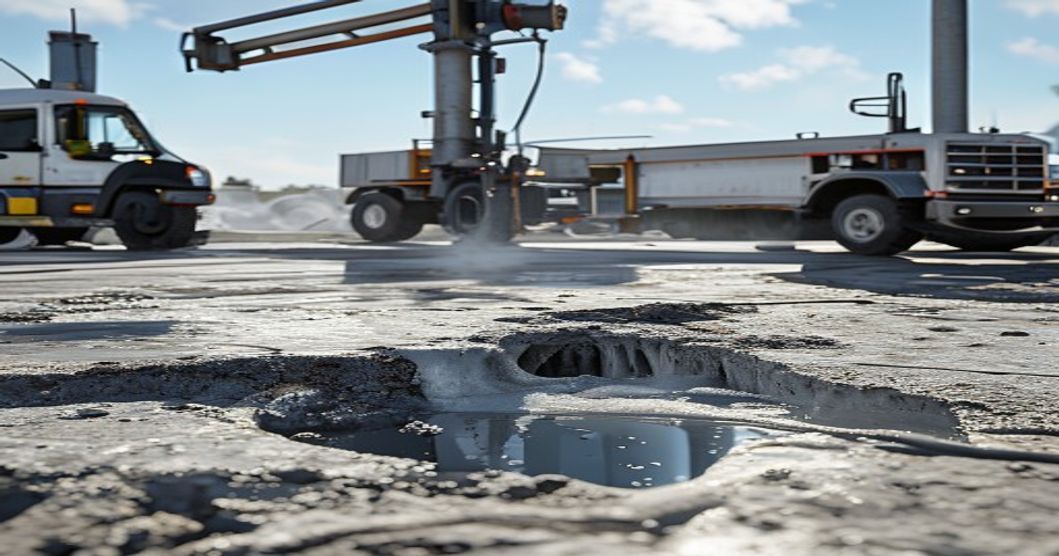
Quick answer. Polyurethane concrete lifting (slab jacking or "polyjacking") raises settled concrete by injecting a two-component, high-density structural foam through small ports drilled in the slab. The foam expands and develops compressive strength in minutes, lifting driveways, warehouse floors and roadways with almost no added weight. The core hardware is a high-pressure plural-component metering machine — the same family as polyurea/PU spray equipment — with precise 1:1 ratio control, heated hose and a mixing gun fitted with injection fittings. A complete turnkey rig from a Chinese manufacturer typically runs $3,250–$11,200, versus $25,000+ for comparable Graco or PMC systems.
What is polyurethane concrete lifting (slab jacking)?
Concrete slabs settle when the soil beneath them washes out, compacts or erodes, leaving voids. Instead of demolishing and re-pouring, contractors lift the existing slab back to grade. Polyurethane slab jacking does this by drilling a pattern of small ports (typically 5/8" / 16 mm) through the concrete, then injecting an expanding two-component polyurethane that first fills the void, then continues to expand and build pressure under the slab, gently pushing it upward.
Because the chemistry is metered, the lift is controllable — the operator watches the slab with a laser or string line and stops injection the instant it reaches grade. The reaction is exothermic and fast: most structural lifting foams reach functional cure within 15 minutes, so a driveway can be back in service the same hour. The compressive performance of the cured rigid foam is characterized using ASTM D1621, the standard test for compressive properties of rigid cellular plastics, which is the spec sheet number you should ask any foam supplier to provide.
PU slab jacking vs traditional mudjacking
Mudjacking (pumping a cement/sand/soil slurry under the slab) is the legacy method. Polyurethane has displaced it on most professional jobs for four reasons: weight, speed, hole size and durability. The slurry adds thousands of pounds back onto the same weak soil that failed in the first place; structural foam adds almost none.
| Factor | PU Slab Jacking | Traditional Mudjacking |
|---|---|---|
| Injection hole size | 5/8" (16 mm) — nearly invisible patch | 1–1.5" (25–38 mm) — visible plugs |
| Added weight to soil | ~2–4 lb/ft³ foam (very light) | ~100+ lb/ft³ slurry (heavy) |
| Cure / return to service | ~15 minutes | 24–72 hours |
| Water resistance | Closed-cell, won't wash out | Can erode again |
| Equipment | High-pressure plural-component rig | Slurry pump + mixer |
| Typical cost per job | Higher material, lower labor/downtime | Lower material, slower job |
The net result is that PU jobs cost more per gallon of material but win on labor, downtime and longevity — which is exactly why the buyer's question is usually "which machine do I buy," not "which method."
How the equipment works
A concrete lifting foam machine is a plural-component, high-pressure metering system. Two liquid streams — the isocyanate (A side) and the resin/polyol blend (B side) — are stored in heated tanks or drums, drawn by proportioning pumps, pushed through heated hoses, and combined only at the mixing head, where they react and begin to foam. The four control variables that determine lift quality are:
- Ratio control — structural foams are mixed at a fixed volumetric ratio (commonly 1:1). Off-ratio foam is weak or sticky and will not develop rated compressive strength.
- Pressure — high-pressure machines (1,500–3,000 psi class) atomize and mix the components mechanically inside the gun, giving consistent cell structure without solvent flush.
- Temperature — heated hose and tank heaters keep both components at reaction temperature so viscosity and rise time stay predictable on cold days.
- Injection ports — the gun is fitted with a port adapter instead of a spray tip, sealing into the drilled hole so foam goes under the slab, not onto the surface.
This is the same metering architecture used in our high-pressure spray machines, which is why one rig can run both polyurea coating and structural lifting foam by changing the gun head and chemistry. For the highest-output lifting work, contractors typically choose a hydraulic-driven proportioner such as the hydraulic spray machine or a heavy-duty model like the JYYJ-H-V8T; smaller crews and indoor void-filling jobs favor a portable electric unit like the electric spray machine.
Why high-pressure (not low-pressure cartridge guns)?
Disposable cartridge "foam jacking" kits exist, but they cap output, run hot, and cost far more per board-foot at volume. A proportioner-based rig pays back fast for any contractor doing more than a few jobs a month because it draws from bulk drums, maintains ratio automatically, and runs continuously.
Key machine specs to compare
When you evaluate a concrete raising machine, compare these on equal terms — not just headline price:
| Spec | What to look for | Why it matters |
|---|---|---|
| Output | Lifting foam needs steady mid-range output; 8–20 kg/min typical | Too low = slow jobs; rise must outpace void |
| Pressure rating | High-pressure plural-component, 1,500–3,000 psi class | Consistent mix without solvent flush |
| Mixing head / gun | Mechanical-purge gun + injection port adapter | Reliability, fewer crossover failures |
| Heated hose | Heated, length matched to your reach (15–60 m) | Stable viscosity in cold weather |
| Mobility | Skid frame or trailer-mounted rig | Drive-up jobs, site access |
| Power | Electric, hydraulic or pneumatic drive | Match to job site power availability |
Pioneer Spray rigs run 25–36 MPa working pressure and ship as a complete turnkey package — proportioner, heated hose, gun, port adapters and start-up support — so you are comparing a ready-to-spray system, not a bare pump.
Applications: where polyjacking pays
- Residential driveways and patios — the bread-and-butter market; fast, clean, same-day return to service.
- Warehouse and factory floors — lifting settled slabs under racking and forklift traffic without shutting down operations for days.
- Roads and highways — municipal slab stabilization and joint lifting where lane-closure time is the real cost.
- Void filling and soil stabilization — filling washouts under pavements, around utilities and behind seawalls.
Because the cured product is an isocyanate-based polyurethane, crews must follow standard PPE and ventilation practices for these chemistries. Review OSHA's guidance on diisocyanate hazards and the EPA's spray polyurethane foam program before training operators — the same safety basics apply to lifting foam as to spray foam insulation.
Sourcing lifting rigs: China vs Graco / HMI
The proportioning technology is mature and well understood; the difference between a $25,000 brand-name rig and a $3,250–$11,200 Chinese turnkey system is mostly brand premium and parts-channel markup, not raw capability. What you should actually verify when sourcing offshore:
- Pressure and ratio under load — ask for a test run video at your target output.
- CE marking and documentation — required for import into the EU and a useful baseline elsewhere.
- Parts support — seal kits, gun parts and heater elements are wear items; confirm they ship fast and that the gun uses a serviceable, common design.
- Foam compatibility — confirm the machine is rated for high-density structural geotechnical foam, not just open-cell insulation.
The strongest value case is the turnkey bundle: a complete Pioneer Spray rig lands at a fraction of a comparable Graco package while delivering equivalent 25–36 MPa high-pressure plural-component metering. For a contractor entering the slab jacking market, the equipment savings often cover the first several months of material.
FAQ
Q: What foam density and compressive strength do I need for slab jacking?
Lifting jobs use high-density structural foam, commonly in the 3–6 lb/ft³ range, with compressive strength rated per ASTM D1621. Heavier loads (highways, industrial floors) call for higher-density formulations — always match the foam's rated compressive strength to the slab load, and ask your chemical supplier for the D1621 data sheet.
Q: How long until the foam sets and the slab can carry load?
Most structural lifting foams reach functional cure in about 15 minutes, which is why driveways and floors typically return to service the same hour. Full chemical cure continues for several more hours but does not delay use.
Q: Do I need a high-pressure machine, or will a low-pressure kit work?
For occasional one-off repairs a cartridge kit can work, but for any volume a high-pressure plural-component proportioner is far cheaper per board-foot, maintains ratio automatically, and runs continuously from bulk drums. It pays back within a handful of jobs.
Q: What is the MOQ and lead time for a turnkey rig from China?
Pioneer Spray sells single complete machines — there is no multi-unit MOQ for the equipment itself. Standard configurations typically ship within roughly 7–15 working days after order; custom hose lengths or voltage options may add a few days.
Q: Can the same machine spray polyurea coatings too?
Yes. Because slab jacking and polyurea/PU spray both use high-pressure plural-component metering, one rig handles both by swapping the gun head and chemistry — letting a contractor offer lifting, coating and void-filling services from a single capital purchase.
Q: How much does a complete concrete lifting foam machine cost?
A turnkey Pioneer Spray system runs $3,250–$11,200 depending on output, drive type and hose configuration — typically less than half the cost of an equivalent Graco or PMC package, with the same 25–36 MPa working pressure.