
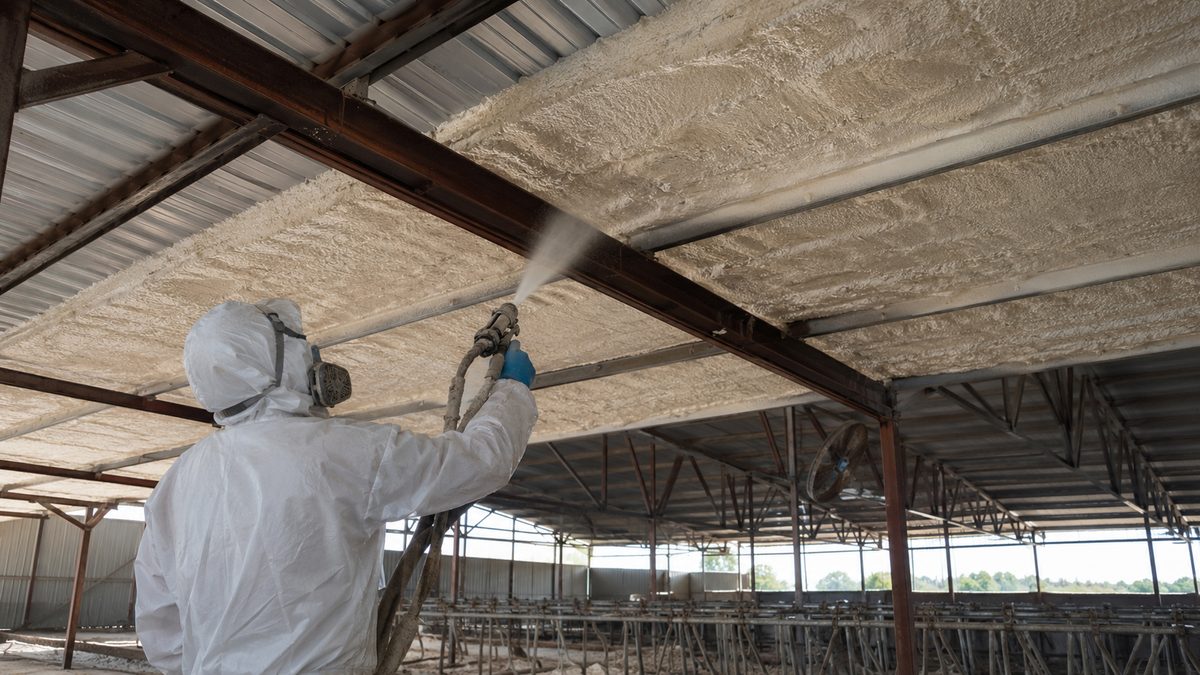
Why Farm Buildings Across Latin America Are Switching to Spray Foam
From dairy operations in the Argentine and Uruguayan pampas to broiler complexes in the Brazilian interior and hog barns in Mexico, the building envelope has become a production variable. An uninsulated metal-roof shed radiates summer heat straight onto the animals below, then drips condensation onto bedding through the cold months. Heat stress cuts feed conversion and milk yield; wet bedding drives respiratory disease. Argentina's animal-health authority publishes official recommendations on preventing heat stress in farm poultry precisely because the problem is structural, not seasonal.
Closed-cell polyurethane spray foam answers both failure modes with a single monolithic layer: roughly R-6 to R-7 of thermal resistance per inch, a seamless air seal over every purlin and fastener, and a rigid skin that tolerates pressure washing. That is why it has become the default retrofit for livestock buildings — our application pages on livestock and barn spray foam insulation and poultry house insulation cover the building-science side in depth. This guide covers the other half: what a contractor serving agricultural clients in Latin America needs in terms of specification, equipment, and import logistics.
What Each Building Type Demands
Dairy barns
Free-stall and tie-stall barns need stable interior temperatures and, above all, condensation control — a dripping roof over stalls is a mastitis and hoof-rot problem, not just a comfort issue. The University of Minnesota Extension's dairy housing resources document the ventilation-insulation balance that modern barns are built around. Foam goes on the roof deck and upper sidewalls in most retrofits. Dairy is also where the scale is global: the FAO counts some 150 million households worldwide engaged in milk production, and in warm climates the barn envelope decides summer yield.
Hog barns
Farrowing and nursery rooms hold the tightest temperature bands in agriculture, and they get washed down constantly. Closed-cell foam is preferred here because its sealed cells shrug off moisture and detergent cycles that destroy fibrous insulation.
Poultry houses
Broiler and layer houses combine high bird density, ammonia, and litter dust. A continuous foam layer on the ceiling keeps radiant heat off the flock in summer and holds brooding temperatures in winter without gaps for rodents to nest in.
Grain and feed storage
Steel silos and feed sheds sweat. Condensation inside the structure cakes and spoils stored feed; a sprayed monolithic layer keeps interior steel above the dew point and seals entry points against pests.
The Specification a Contractor Must Hit
- Density: agricultural closed-cell work is typically applied at about 32 kg/m³ (2.0 lb/ft³). Below spec density, foam loses compressive strength and moisture resistance.
- Thickness: set by climate zone and target R-value, built up in controlled passes — never in one thick lift.
- Substrate: surfaces must be clean of manure dust and dry, with ambient and substrate temperatures inside the foam system's window.
- Fire protection: most jurisdictions require a thermal or ignition barrier over exposed foam in occupied barns — check the local code before quoting.
- Worker protection: the A-component is an isocyanate — crews follow OSHA's isocyanate exposure guidance: supplied-air respirators and ventilation while spraying, in a barn as on any enclosed site.
Why a Low-Pressure Kit Cannot Do This Work
A galpón roof runs hundreds or thousands of square meters. Covering it at spec density requires holding chemical temperature, pressure, and the A:B mixing ratio steady for hours — which is exactly what disposable low-pressure kits cannot do. Off-ratio foam on an agricultural job means low density, poor adhesion, and a failed inspection over a very large area.
The working range for this class of work is a heated, high-pressure plural-component proportioner in the 25–36 MPa band. In the JYYJ line, two hydraulic machines carry most agricultural projects:
- JYYJ-H600PK — 36 MPa working pressure, 2–10 kg/min output, adjustable 1:1 to 1:2 mixing ratio, 7-inch PLC touchscreen with recipe memory, 26 kW / 22 kW heating, 15 m heated hose, 354 kg net. The adjustable ratio absorbs viscosity swings from temperature — useful when a rural jobsite is cold at dawn and hot by noon.
- JYYJ-H600 — the entry point to professional pressure: 36 MPa, 2–12 kg/min, fixed 1:1 ratio, same heating package. For crews running standard foam systems without formulation changes.
Rural power is the other half of the equipment question. Farm grids sag, and generators are often the real power source — see our guide to running spray foam equipment on unstable power and off-grid sites before you spec the rig.
Voltage, Climate and Import Logistics
- Voltage: the standard build is 380V 3-phase 50Hz; machines are configured at the factory for the destination market, including 60 Hz grids such as Brazil, Mexico, and Colombia. Confirm your farm's actual supply before ordering — not the nominal national standard.
- Shipping: sea freight to Latin American ports typically runs 40–50 days, shipped FOB Shanghai, CIF, or DDP.
- Certification: JYYJ machines carry CE certification under the EU Machinery Directive. For Brazil, INMETRO homologation is handled through local partners.
- Commissioning: every machine ships with remote start-up support and operator training video; Mexican buyers should also read our Mexico contractor buying guide for cluster-specific logistics.
How to Quote an Agricultural Job
- Measure the envelope — roof deck, sidewalls, end walls — and agree with the owner on which surfaces get foam.
- Fix density and thickness from the climate zone and target R-value, and write both into the contract as acceptance criteria.
- Confirm chemical supply: Pioneer supplies its own A-component formulations (All-Water and HFO blowing agents) with the B-component from BASF, Dow, Huntsman, or Wanhua at your choice, or tunes the machine to your local system.
- Plan power and access: generator sizing, hose run from the rig to the farthest bay, and washdown scheduling with the farm.
Frequently Asked Questions
Which machine fits a contractor starting in agricultural insulation?
Crews standardizing on one foam system usually start with the JYYJ-H600; contractors mixing agricultural foam work with polyurea jobs — tank lining, pond lining — choose the JYYJ-H600PK for its adjustable ratio.
Can the same machine spray barns and do waterproofing?
Yes. Hydraulic JYYJ machines handle PU foam and polyurea; changing between them is a chemical-system and parameter change, not a different rig.
Do you sell the foam chemicals too?
Pioneer manufactures the machines, heated hoses, and guns, and supplies A-component formulations with brand-name B-component — one of the few suppliers covering both sides. We do not lock you to our chemistry; the machine can be tuned to any qualified agricultural system.
Planning a barn, poultry house, or feed-storage insulation project? Tell our engineers the building dimensions, your grid voltage, and target foam spec, and we will recommend a machine configuration within 24 hours.