
Polyurea Mining & Wear Lining
Fast-set pure polyurea spray lining for chutes, hoppers, truck beds, and slurry lines — a seamless, abrasion-resistant wear coat that returns mining assets to service in minutes.
Polyurea Mining and Wear Lining: Equipment and Application Guide
In a mineral-processing plant or an open-pit operation, abrasion is a constant cost. Ore, slurry, and rock grind down steel chutes, hoppers, truck beds, and pipelines around the clock, and every hour a worn asset spends offline is lost production. Sprayed pure polyurea has become the wear-lining material of choice because it goes on as a seamless, monolithic elastomer that absorbs impact, shrugs off abrasion, and gels in seconds, so a lined chute can be back under load the same shift.
This page explains why polyurea is used for mining wear protection, where it is applied, and what equipment you need. Pioneer Spray builds the high-pressure, heated, plural-component machines that abrasion-coating contractors rely on to spray fast-set polyurea on schedule, including the heavy hydraulic JYYJ-H-V8T.
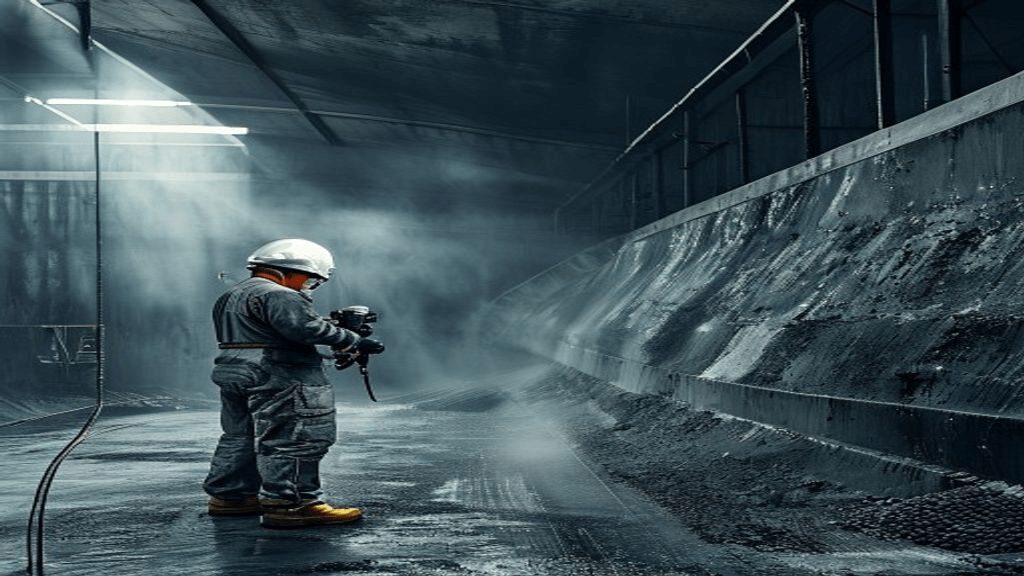
Why polyurea is the standard for mining wear protection
Mining assets fail at the contact face, where sharp ore and high-velocity slurry attack steel faster than maintenance can keep up. Pure polyurea answers that with a tough, elastic film that no bolt-on liner or epoxy can match across the same range of conditions.
- Extreme abrasion and impact resistance. Polyurea combines high tensile strength with high elongation, so it both resists gouging from sliding ore and rebounds from the impact of dropped rock instead of cracking. Abrasion-grade formulations are routinely qualified against weight-loss tests such as the ASTM D4060 Taber abrasion standard.
- Fast set and return to service. Pure polyurea gels in seconds and is walk-on hard within minutes, not days. A chute or truck bed can be sprayed and back in service the same shift, where a slow-curing epoxy or rubber liner would idle the asset for hours.
- Seamless monolithic film. Sprayed in place, polyurea forms one continuous skin with no seams, bolt holes, or laps for slurry to undercut. Bolt-on ceramic and rubber liners fail at the joints; a sprayed coat has none.
- Corrosion and slurry chemical resistance. A dense, closed polyurea film blocks the acidic and saline process water that pits bare steel, protecting the substrate from the combined wear-plus-corrosion attack typical of mineral-processing circuits.
- Conformable to complex geometry. Because it is sprayed as a liquid, polyurea coats curved chutes, cyclone cones, launders, and pipe interiors that rigid liners cannot follow, building uniform thickness over edges and corners that bolt-on plate leaves exposed.
Where polyurea wear lining is used
Chutes and Transfer Points
Transfer chutes take the hardest hits in a plant, with ore dropping and sliding at every belt junction. A sprayed polyurea liner absorbs the impact and abrasion that quickly grooves bare steel and tears bolt-on liners.
Hoppers and Bins
Surge hoppers, feed bins, and storage silos are lined with seamless polyurea to resist sliding-ore abrasion and to keep sticky, wet material flowing instead of hanging up on worn, pitted walls.
Haul Truck Beds and Dump Bodies
Dump bodies and haul truck beds are sprayed with high-build polyurea to cushion the loading impact of large rock, cut bed wear, and reduce carry-back so payloads release cleanly and faster.
Slurry and Tailings Pipelines
The inside of slurry, tailings, and dredge pipelines is lined with polyurea to survive the combined abrasion and corrosion of high-velocity, abrasive process water that erodes unprotected pipe wall.
Screens and Cyclones
Cyclone cones, screen frames, and classifier surfaces see fast, fine, abrasive slurry. A conformable polyurea coat follows their curved geometry where rigid ceramic tile cannot, extending service life between rebuilds.
Flotation Cells and Launders
Flotation cells, launders, and trough surfaces are coated with polyurea to resist the abrasive, corrosive slurry of the concentrator and to provide a smooth, low-friction surface that keeps froth and pulp moving.
The wear-lining application process
Spraying pure polyurea wear lining is a controlled, two-component process. Adhesion and service life depend on substrate preparation, accurate machine settings, and disciplined technique.
- 1. Surface preparation and primer. The steel substrate is abrasive-blasted to a near-white profile to remove mill scale, rust, and contamination, then a compatible primer is applied. On mining wear surfaces this prep step is what stops disbondment under impact load.
- 2. Machine setup. The plural-component machine heats both the isocyanate and resin sides to the recommended temperature and pressurizes them to spec, holding a precise 1:1 ratio and high pressure all the way to the gun so the fast-set chemistry mixes and atomizes correctly.
- 3. Spray to target mil thickness. Polyurea is sprayed in controlled passes to build the wear thickness the duty demands, commonly 60 to 250 mils (about 1.5 to 6 mm) depending on impact severity, with extra build at high-wear contact zones.
- 4. Cure and inspection. The film is tack-free in seconds and serviceable within minutes. Crews verify dry-film thickness with a gauge, run a holiday (pinhole) test on critical surfaces, and confirm a continuous monolithic coat before the asset returns to load.
The equipment you need: high-pressure plural-component machines
Pure, fast-set polyurea cannot be applied with low-pressure or unheated equipment. It is a 1:1 plural-component material that gels in seconds, so it must be heated to roughly 60 to 70 degrees Celsius and sprayed at high pressure to atomize and mix the two streams before they react. Pioneer Spray machines operate in the 25 to 36 MPa range required to drive this chemistry reliably.
Low-pressure foam kits and cartridge guns cannot reach the temperature, pressure, or ratio control that pure polyurea demands; the result is poor mixing, soft spots, and a liner that delaminates under the first impact. For heavy mining wear coating, the hydraulic JYYJ-H-V8T delivers the high output and stable pressure needed to spray thick polyurea builds across large chutes, beds, and pipelines without starving the gun.
Not sure which JYYJ model fits your wear-coating workload, polyurea supplier, or jobsite power supply? Contact our engineers and we will recommend a machine, hose, and gun configuration for your mining application.
Frequently Asked Questions
Which Pioneer Spray machine is best for mining wear coating?
For heavy, fast-set pure polyurea on chutes, truck beds, and pipelines, the hydraulic JYYJ-H-V8T is the usual choice because of its high output and stable high pressure. The JYYJ-H800 and JYYJ-H600PK also handle abrasion-grade polyurea well for smaller crews or lower daily volumes.
Do you supply the polyurea material as well?
Pioneer Spray manufactures the spray machines, hoses, and guns rather than the chemical. We work with your existing abrasion-grade polyurea supplier and configure the machine heat, pressure, and ratio to that specific material so it sprays and cures on spec.
What polyurea thickness is typical for mining wear lining?
Mining wear coats are commonly applied at 60 to 250 mils (about 1.5 to 6 mm), with the exact build set by impact severity and slurry velocity. High-wear contact zones such as chute impact plates receive extra thickness, and dry-film thickness is verified with a gauge after spraying.
Can a low-pressure kit spray polyurea wear lining?
No. Pure polyurea gels in seconds and needs a high-pressure, heated, plural-component machine to hold the correct temperature, 1:1 ratio, and atomization. Low-pressure kits cannot mix it properly, producing soft spots and poor adhesion, which is why machines such as the JYYJ-H-V8T are used.
Recommended JYYJ Machines
JYYJ-H-V8T
Pioneer's top-tier flagship — the highest-output PLC-controlled spray machine in the JYYJ line. 2-15 kg/min at 36 MPa with 10-inch PLC touchscreen, one-click start/stop operation, and low-temperature protection that prevents incomplete mixing in cold conditions. Flat-mounted booster pump design reduces footprint while maintaining the highest output. Ideal for the most demanding industrial polyurea and polyurethane projects.
JYYJ-H800
Maximum-throughput hydraulic spray machine with simple button controls. 2-14 kg/min at 36 MPa with 38 kW heating — the highest heating power in the JYYJ line for sub-zero environments. Built for large industrial projects where output volume matters more than touchscreen sophistication.
JYYJ-H600PK
Flagship hydraulic spray machine with 10-inch PLC touchscreen and adjustable mixing ratio (1:1~1:2). 2-10 kg/min at 36 MPa for polyurea, high-density foam, and precision-critical applications. Recipe memory and data logging for project documentation. Adjustable ratio handles temperature-driven viscosity shifts and custom material formulations — unique in the JYYJ line.
Recommended Materials
Browse Polyurea Coating (A + B) →- ● Pure fast-set polyurea elastomer (1:1, gels in seconds)
- ● High-elongation abrasion-grade polyurea for impact wear
- ● Optional aromatic body coat with aliphatic topcoat where UV color stability matters
Why This Setup Works
Seamless monolithic polyurea coat — no bolt holes or laps for slurry to undercut
Fast set returns chutes, beds, and pipelines to service the same shift
High tensile strength plus high elongation resists both sliding abrasion and impact
Dense closed film blocks corrosive, saline process water on bare steel
Technical Considerations
- Typical build 60-250 mils (1.5-6 mm); extra thickness at high-wear impact zones
- Steel must be abrasive-blasted to near-white and primed for impact-load adhesion
- Pure polyurea needs 1:1 ratio, 60-70C heat, and 25-36 MPa high-pressure spray
- Verify dry-film thickness and run a holiday (pinhole) test on critical surfaces
Real Projects in Polyurea Mining & Wear Lining
Projects for this application are being documented. Share your project requirement and we'll send relevant reference cases.
See Polyurea Mining & Wear Lining in Practice
YouTube demonstration videos
@YongjiaPolyurethanemachinepuFrequently Asked Questions
What JYYJ machine is best for polyurea mining & wear lining?
Do you supply the raw materials too?
How long is shipping to Russia / LATAM / Middle East?
Do you provide technical training and installation support?
What certifications does the equipment have?
Planning a polyurea mining & wear lining project?
Share your output, voltage, and project scale. Pioneer recommends a matched JYYJ machine + material combination within 24 hours.