
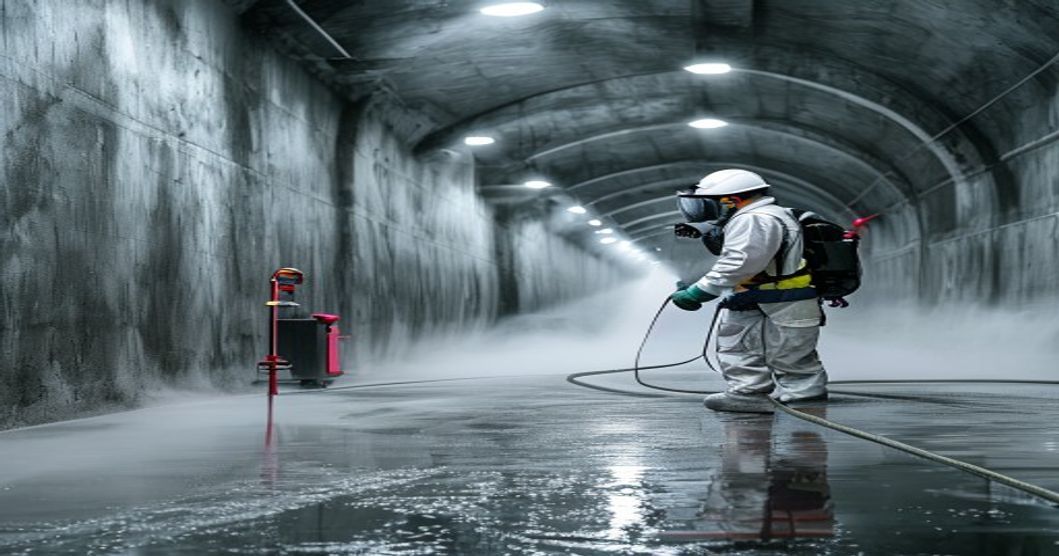
Quick answer. A polyurea cistern liner is a seamless, spray-applied elastomeric membrane that seals cracks, stops leaks, and creates an inert barrier between stored water and a concrete or steel tank. For potable (drinking) water, the coating must be certified to NSF/ANSI 61, applied over properly prepared substrate with a two-component, heated, high-pressure plural-component sprayer. A turnkey JYYJ spray package rehabilitates most cisterns in one to two days at a fraction of the tank-replacement cost.
Why Cisterns and Water Storage Tanks Fail
Cisterns are unforgiving assets. They are buried or half-buried, they cycle between full and empty, and they hold a liquid that finds every weakness. The three failure modes we see repeatedly on rehabilitation jobs are structural cracking, joint and penetration leakage, and surface contamination.
- Cracking: Concrete cisterns crack from shrinkage, freeze-thaw, hydrostatic pressure, and ground movement. Once a crack opens beyond roughly 0.3 mm, it will weep, and a weeping crack in a potable tank is both a water-loss problem and a contamination pathway.
- Leakage at cold joints and penetrations: The junction between floor and wall, and every pipe boot or fitting, is a stress concentration. Rigid coatings and cementitious patches crack again at these movement points.
- Contamination: Bare concrete leaches calcium and raises pH; corroded steel sheds iron and rust into the water column. Biofilm colonizes rough, porous surfaces, and once established it is nearly impossible to fully disinfect.
Traditional fixes — cementitious parge coats, sheet liners, or epoxy — either re-crack at the same movement points or leave seams and lap joints that become new leak paths. This is where a monolithic, high-elongation membrane changes the economics of the repair.
Why Polyurea for Potable Water Cisterns
Polyurea is a two-component elastomer (an ISO/amine-resin system) that cures in seconds when sprayed hot at high pressure. Three properties make it the modern choice for cistern and water-tank lining:
- Seamless and crack-bridging: A spray-applied membrane has no laps, no welds, and no seams. With elongation typically between 200% and 400%, it bridges existing hairline cracks and accommodates ongoing thermal and structural movement without splitting.
- Fast cure, fast return to service: Gel times of 3–15 seconds and tack-free times measured in minutes mean a cistern can be lined, cured, disinfected, and refilled far faster than with slow-cure epoxies that need days.
- Inert, cleanable barrier: Once cured, a certified potable-grade polyurea is chemically inert, does not leach, and presents a smooth, non-porous surface that resists biofilm and is easy to disinfect.
The critical caveat: only NSF/ANSI 61 certified formulations may contact drinking water. This is not optional. In the United States, drinking-water systems are governed by the Safe Drinking Water Act administered by the U.S. Environmental Protection Agency, and product certification to consensus standards is the accepted way to demonstrate a material is safe for potable contact. Always confirm the exact resin lot you spray carries a valid NSF/ANSI 61 listing.
Concrete vs. Steel Cisterns: What Changes
The membrane chemistry is the same, but the substrate dictates preparation and primer selection. The table below summarizes how the two most common cistern types differ from a lining standpoint.
| Factor | Concrete Cistern | Steel Cistern |
|---|---|---|
| Primary defect | Cracks, porosity, leaching, spalling | Corrosion, pitting, seam/weld leaks |
| Surface prep | Abrasive blast / shot blast to CSP 3–5, patch bug-holes | Abrasive blast to near-white (SSPC-SP10), remove all rust |
| Moisture control | Critical — must test for moisture & outgassing before spray | Control dew point; spray above dew point + 3°C |
| Primer | Moisture-tolerant epoxy primer for adhesion & blocking | Epoxy anti-corrosion primer over blasted steel |
| Typical DFT (dry film) | 1.5–3.0 mm polyurea | 1.5–2.5 mm polyurea |
| Adhesion target | >1.5 MPa pull-off (ASTM D7234) | >2.0 MPa pull-off (ASTM D4541) |
Adhesion is verified with pull-off testing per standards published by ASTM International (ASTM D7234) for coatings on concrete. Documenting pull-off values on every job is what separates a warrantable potable liner from a coating that delaminates in the first season.
Surface Prep and Spray Application
Ninety percent of liner failures trace back to preparation, not chemistry. The sequence for a cistern rehabilitation is disciplined:
- Drain, clean, and inspect. Remove all standing water, sediment, and old coating. Map cracks and active leaks.
- Confined-space controls. A buried cistern is a permit-required confined space. Follow ventilation, atmospheric monitoring, and entry procedures per OSHA confined-space regulations. This protects your crew and is a hard requirement, not a suggestion.
- Abrasive blast. Bring concrete to a Concrete Surface Profile of CSP 3–5; bring steel to a near-white metal blast. Repair spalls and structural cracks with an approved mortar or resin.
- Prime. Apply the matched moisture-tolerant epoxy primer and let it reach the manufacturer's recoat window.
- Spray polyurea. Apply the certified potable membrane in even passes to target DFT, keeping the substrate above dew point and the material at proper temperature and pressure.
- Cure, test, disinfect, refill. Verify DFT and adhesion, chlorinate/disinfect per local health authority, flush, and return to service.
The spray step is where equipment quality decides the outcome. Polyurea must be delivered at roughly 2,000–2,500 psi with both A and B sides heated to 65–75°C and precisely 1:1 ratio. Cold, low-pressure, or off-ratio spray produces soft spots, poor cross-link, and — in a potable tank — a liner that never fully cures. That is a health risk, not just a cosmetic one.
Equipment: Turnkey Spray Packages vs. Buying Piecemeal
Contractors moving into cistern and water-tank lining face a choice: assemble a proportioner, heated hose, spray gun, feed pumps, and compressor from separate suppliers, or buy a matched turnkey package. Pioneer Spray builds complete, pre-matched systems specifically for this work, and the price gap against the incumbents is substantial.
- For most municipal and commercial cisterns, our workhorse hydraulic proportioner — the JYYJ-H600 — delivers the 25–36 MPa pressure and stable heat that certified polyurea demands, in a single skid-mounted unit.
- For high-output crews lining large reservoirs or running back-to-back jobs, the higher-flow JYYJ-H-V6T shortens spray time on big surface areas without sacrificing ratio control.
- Where facility power is limited or you need a rugged general-purpose platform, the hydraulic spray machine line covers the same performance envelope with proven components.
Every JYYJ package ships as a complete kit — proportioner, heated hose, spray gun, and the fittings you actually need on site — so a crew can be productive on day one instead of chasing compatibility issues between mismatched parts.
| Consideration | Pioneer Spray turnkey (JYYJ) | Graco / PMC comparable |
|---|---|---|
| Complete turnkey kit price | $3,250 – $11,200 | $18,000 – $45,000+ |
| Working pressure | 25–36 MPa (3,600–5,200 psi) | Comparable |
| What's included | Proportioner + heated hose + gun + fittings | Often proportioner only; hose/gun extra |
| Ratio / heat control | 1:1 fixed, dual-side heat, digital readout | 1:1 fixed, dual-side heat |
| Payback on first jobs | Often 1–3 cistern jobs | Many more jobs to recover cost |
The performance envelope is equivalent for cistern-lining work; the difference is capital cost and how fast the machine pays for itself. A crew that recovers its equipment investment in the first few jobs can price more competitively and take on more rehabilitation contracts.
Rehabilitate vs. Replace: The Economics
Replacing a concrete or steel cistern means excavation, demolition, new construction, and weeks of downtime — frequently tens of thousands of dollars before the water is even back on. A polyurea rehabilitation lines the existing structure in place, in one to two working days, and extends service life by 15–20 years. When the tank shell is structurally sound and the problem is cracking, leakage, or contamination, lining is almost always the lower-cost, faster-return-to-service choice. Replacement makes sense only when the structure itself has failed.
For contractors, the strategic point is that owning the right sprayer converts a specialty subcontract into an in-house service line. Explore our full water tank lining and industrial tank lining application guides, and the broader polyurea waterproofing capabilities, to see where the same equipment earns across multiple markets.
FAQ
Q: Is polyurea safe for drinking-water (potable) cisterns?
Yes — but only formulations certified to NSF/ANSI 61 for potable contact, applied at the correct thickness and fully cured. The certification applies to specific resin systems, so confirm the exact product you spray carries a valid listing, and always disinfect the tank before returning it to service.
Q: How long does a polyurea cistern liner last?
A properly prepared and correctly sprayed liner typically provides 15–20 years of service, and often longer when it stays submerged and protected from UV. Adhesion and film thickness at installation are the biggest drivers of longevity.
Q: Can I line a cistern that still has minor active leaks or cracks?
Active structural cracks and flowing leaks must be repaired and stabilized first with an appropriate mortar or resin. Polyurea bridges hairline and dormant cracks thanks to its high elongation, but it is a membrane, not a structural repair — the substrate must be sound before spraying.
Q: What equipment do I need to spray a potable cistern liner?
A heated, high-pressure, plural-component proportioner delivering ~2,000–2,500 psi with both components heated to 65–75°C at a precise 1:1 ratio, plus a heated hose and impingement spray gun. A turnkey package like the JYYJ-H600 includes everything matched; low-pressure or unheated units cannot properly cure polyurea and are not suitable for potable work.
Q: How much does it cost to line a cistern versus replacing it?
Lining an existing sound tank is usually a fraction of replacement cost and restores service in 1–2 days instead of weeks. On the equipment side, a complete Pioneer Spray turnkey system runs $3,250–$11,200 — well below comparable Graco/PMC configurations — so contractors often recover the machine cost within the first few jobs.