
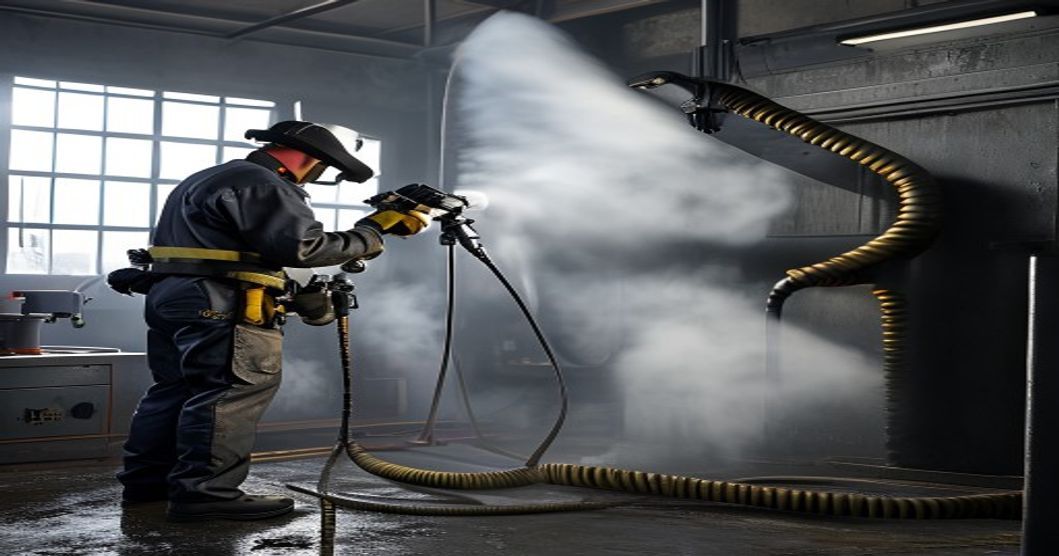
Quick answer. A new Graco Reactor 2 or PMC PHX/Proportioner rig typically lands a finished, ready-to-spray package between US$28,000 and US$60,000+ once you add the heated hose, spray gun, transfer pumps, and air dryer. A comparable China turnkey polyurea/polyurethane spray machine from Pioneer Spray ships as a complete kit for roughly US$3,250 to US$11,200 — the proportioner, heated hose, gun, and core accessories included. For contractors who need 25–36 MPa output and stable A/B ratio without paying for a premium brand name, the gap is real and measurable.
What "Graco Reactor price" actually means
The single biggest mistake buyers make is comparing a bare proportioner sticker price against a competitor's complete rig. Graco and PMC publish (or distributors quote) a price for the proportioner only — the heated machine that meters and heats the A-side (isocyanate) and B-side (resin). That number is not what you spray with.
A working high-pressure plural-component setup needs, at minimum:
- The proportioner / reactor unit (the heated metering core)
- A heated hose, usually 50–310 ft, with a temperature sensor down the whole length
- An impingement-mix spray gun (Fusion AP, Fusion CS, or P2 class)
- Two transfer/feed pumps for the drums
- A compressed-air supply with a desiccant air dryer (moisture kills isocyanate)
- Spare mix chambers, o-kits, lube, and screens
Stack those onto a mid-range Reactor 2 E-30 and the all-in number climbs fast. That is why a quoted "Graco Reactor price" of, say, US$22,000 becomes a US$35,000–US$45,000 rig before you spray your first square meter.
Side-by-side cost and spec comparison
The table below compares a typical mid-output Graco/PMC class rig with two Pioneer Spray turnkey machines. Figures are indicative 2026 reference points for a complete, ready-to-spray package — always confirm a live quote because exchange rates, freight, and accessory choices move the final number.
| Item | Graco Reactor 2 / PMC class (complete rig) | Pioneer Spray hydraulic turnkey | Pioneer Spray electric turnkey |
|---|---|---|---|
| Complete package price (USD) | $28,000 – $60,000+ | $7,800 – $11,200 | $3,250 – $6,500 |
| Max working pressure | ~24–34 MPa (3,500–5,000 psi) | 25–36 MPa | 25–32 MPa |
| Output (kg/min, polyurea) | ~6–14 | ~8–15 | ~3–8 |
| Heated hose included | Add-on, $3,000–$8,000 | Included | Included |
| Spray gun included | Add-on, $1,800–$3,500 | Included | Included |
| Spare parts cost | Premium, brand-locked | Standard, low cost | Standard, low cost |
| Lead time | Often 4–10 weeks via distributor | Stock / 1–3 weeks | Stock / 1–3 weeks |
The headline is not just the lower entry price. It is that a Pioneer Spray rig is quoted as a turnkey package — the hose, gun, and core accessories are inside the number, so there is no second invoice that doubles your budget.
Where Graco and PMC justify the premium — and where they don't
Let's be fair. Graco and PMC have earned their reputation. Their advantages are real for a specific buyer profile:
- Global service network. If you operate in North America or Western Europe and need same-week parts and certified field techs, the dealer footprint matters.
- Brand acceptance on large contracts. Some general contractors and spec writers list Graco by name.
- Decades of mix-chamber R&D. Mature documentation and operator training material.
Where the premium is harder to justify: the core physics of high-pressure impingement mixing is well understood and not proprietary. A heated proportioner that holds A/B ratio at 1:1, hits 70 °C primary heat, and sustains 25–36 MPa does the same job whether the badge says Reactor or Pioneer. For a growing contractor, an OEM building tanks, or a distributor in the Middle East, Africa, Latin America, or Southeast Asia, paying a 3–5x premium for a name on the proportioner rarely pencils out.
Total cost of ownership, not just sticker price
Smart buyers compare the five-year cost, not the day-one cost. Three line items dominate after purchase:
- Consumable mix chambers and o-kits. These wear and get replaced regularly. Brand-locked OEM consumables carry a markup; standardized parts on a China rig cost a fraction.
- Downtime. A machine that sits waiting for an overseas-shipped part costs you a job. Stocking common spares locally is cheaper when the spares themselves are cheap.
- Energy and air. Electric and hydraulic spray foam machines differ here — an electric spray machine runs leaner on compressed air for small-to-mid jobs, while a hydraulic spray machine sustains higher continuous output for tank linings and large roofing decks.
Run the math on a contractor doing 40,000 m² of polyurea per year. The equipment delta of US$25,000–US$40,000 between a premium rig and a turnkey China rig is, for many operations, the difference between buying one machine or two — meaning a backup unit that eliminates single-point-of-failure downtime entirely.
Safety and compliance are the same standard, regardless of brand
Price comparison never overrides safety. Polyurea and SPF spraying involves isocyanates (MDI), which are respiratory sensitizers. The machine's badge does not change your obligations. Operators must use supplied-air or appropriate respiratory protection and follow established exposure controls — review the U.S. OSHA guidance on isocyanate hazards and worker protection before any project, and check the EPA's spray polyurethane foam guidance for ventilation, re-occupancy, and product-handling practices.
A reputable turnkey supplier should provide datasheets, operating temperature/pressure windows, and PPE recommendations alongside the hardware. Pioneer Spray ships machines built to hold the same 25–36 MPa working envelope that the chemistry requires, so the application performance — not the safety baseline — is what you are comparing.
Which Pioneer Spray machine maps to which Graco/PMC tier
To make the cross-shop concrete:
- Entry / mobile contractor (replacing a small Reactor E-XP or pneumatic rig): the electric spray machine covers waterproofing, small roofing, and detail work at the lowest entry cost.
- Production contractor (cross-shopping Reactor 2 E-30 / PMC PH-2): the hydraulic spray machine sustains the continuous output and pressure those jobs demand.
- High-volume / industrial linings (cross-shopping Reactor 2 H-40 / PMC PHX-40): the JYYJ-H800 targets the top output band for tank linings, secondary containment, and large infrastructure decks.
FAQ
Q: How much does a Graco Reactor cost as a complete rig?
A bare Reactor 2 proportioner is one number; a finished rig with heated hose, Fusion gun, transfer pumps, and an air dryer typically runs US$28,000–US$60,000+ depending on the model tier and hose length. Always ask a distributor for the all-in package price, not the proportioner-only price.
Q: Is a China spray machine as powerful as a Graco Reactor?
For the core specs that matter — working pressure (25–36 MPa), A/B ratio stability, and heat output — a Pioneer Spray turnkey machine operates in the same envelope. The chemistry sets the requirements, and both platforms meet them. The main differences are brand service network and consumable pricing, not raw capability.
Q: What's actually included in a Pioneer Spray turnkey package?
The proportioner, heated hose, impingement-mix spray gun, and core spare/consumable kit ship together as one quoted price (roughly US$3,250–US$11,200 by model). That is the meaning of turnkey — you are not buying the heated hose and gun on a separate invoice.
Q: Will I struggle to get spare parts for a non-Graco machine?
Pioneer Spray machines use standardized, widely available wear parts (mix chambers, o-kits, screens) at standard cost, and the supplier stocks common consumables. Because the parts are inexpensive, keeping a local shelf of spares is affordable — which is the real defense against downtime.
Q: Do I still need supplied-air respirators with a cheaper machine?
Yes. PPE and exposure controls are driven by the isocyanate chemistry, not the equipment brand. Follow OSHA isocyanate guidance and EPA SPF handling practices on every job regardless of which proportioner you buy.
Bottom line
If your buying decision rests on a North American spec sheet that names Graco, the premium may be unavoidable. For nearly everyone else — distributors, OEMs, and growing contractors who need 25–36 MPa turnkey output without a five-figure accessory bill — a complete China spray rig delivers the same working performance at a fraction of the landed cost, with cheaper consumables and no second invoice for the hose and gun. Compare the all-in package price, the spare-parts economics, and the lead time, and the math usually speaks for itself. Request a turnkey quote and a model-to-model spec comparison before you commit to either brand.