
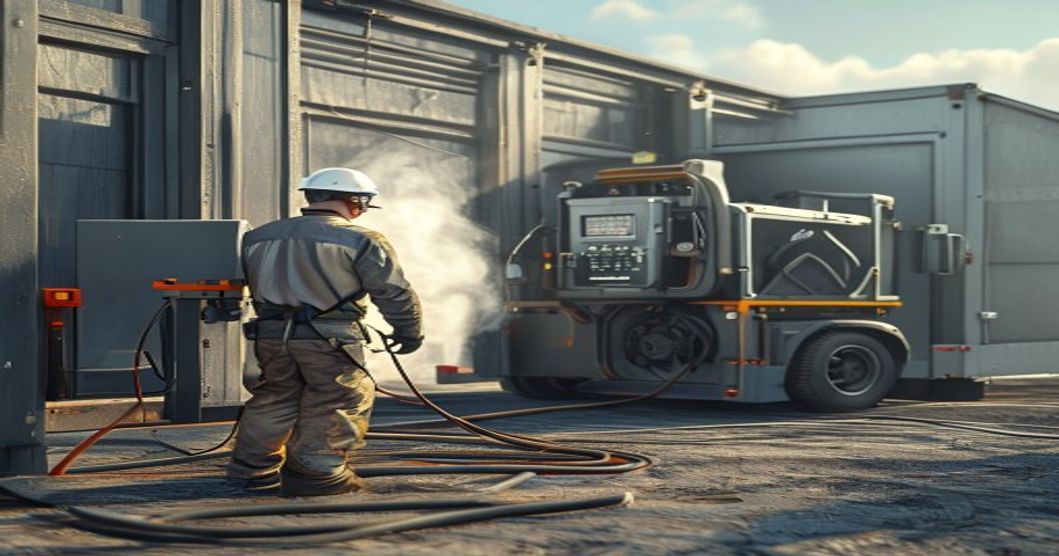
Quick answer. Most single-operator polyurethane and polyurea spray foam rigs need a 15–25 kVA generator, and larger dual-heat or high-output machines climb to 30–45 kVA. The number is driven far more by startup inrush and hose pre-heat load than by the proportioner's nameplate rating — which is exactly why buying "to the sticker" is the fastest way to brown out your heaters or cook the generator's alternator on day one.
If you are speccing a rig right now, the most important thing to understand is this: a spray foam machine is not a steady, well-behaved load. It is a stack of heaters, a main proportioning pump, and (sometimes) an air compressor that all fight for current at different moments. Size the generator for those moments, not for the average. Below we break down why nameplate figures lie, how the three drive types differ, and give you a model-by-model quick chart for our turnkey rigs.
Why Nameplate kW Will Burn Your Machine
Every proportioner lists a running power figure. It is honest — for the running state. The problem is that electric motors and heaters do not sip current smoothly the way that number implies.
- Motor inrush (locked-rotor) current. When the main pump motor or a compressor motor kicks on, it draws a surge of 3–6× its rated current for a fraction of a second. A 5 kW motor can momentarily demand the equivalent of 15–30 kW. A generator sized only to the running total will sag its voltage, the heaters will drop out, and your A:B temperatures will crash mid-spray.
- The "they don't all start together" illusion. Buyers assume the primary heaters and the pump never peak at the same instant, so they discount the total. In reality, cold mornings, a re-start after a hose blockage, or a thermostat calling for full heat while you trigger the gun will all stack loads together. Design for the worst overlap, not the friendly average.
- Heater duty is not optional. Primary drum heaters plus hose heat can be the single biggest continuous draw on the rig. Undersize here and the machine simply never reaches spray temperature in cold conditions — it looks "broken" when it is actually just starved.
The rule of thumb: take the machine's peak running load, then add a headroom multiplier for inrush. A generator's kVA rating (apparent power) — not just kW — is what absorbs those surges, which is why we spec rigs in kVA.
The Three Drive Types Need Very Different Power
This is the part most sizing guides skip, and it is the core of the decision. A pneumatic spray machine, a hydraulic spray machine, and an electric spray machine put fundamentally different demands on your generator. Read the drive type off the spec sheet before you shop for power.
| Drive type | Typical rated kW | Startup surge (approx.) | Recommended generator | Needs air compressor? |
|---|---|---|---|---|
| Pneumatic (air-driven pump) | Pump itself is low, but you must power a separate compressor | Compressor motor surges 3–5× | 20–35 kVA (rig heaters + dedicated compressor) | Yes — compressor kW is the hidden cost |
| Hydraulic (hydraulic power unit driving the pump) | Continuous mid-high load from the HPU motor | Moderate, but sustained high running draw | 25–45 kVA depending on output | Usually no (gun purge air only) |
| Electric (direct electric drive) | Highest instantaneous peak of the three | Sharpest inrush at motor/heater start | 15–30 kVA, but must tolerate high peaks | No (gun purge air only) |
Pneumatic rigs look power-light on paper because the proportioner pump runs on compressed air — but that air has to come from somewhere. The compressor is a large electric load in its own right, and it is the item people forget to add. Hydraulic rigs draw a steadier, higher continuous load because the hydraulic power unit motor runs whenever you spray; they are forgiving on surges but hungry overall. Electric rigs are the most efficient at the wall but have the sharpest peaks, so the generator must have strong voltage recovery, not just enough average watts.
Hose Length Is a Hidden Power Draw
Heated hose is often the most underestimated load on a spray foam rig. Every extra 15 m (50 ft) of hose is more resistance wire that has to be brought up to and held at temperature. The longer your maximum hose length, the more pre-heat kilowatts you burn — and the longer the machine sits drawing near-peak power before you can even pull the trigger.
Two practical consequences:
- If you routinely run long hose to reach roofs, tanks, or the far side of a warehouse, size up a bracket. A rig that is comfortable on 60 m of hose may struggle to pre-heat 90 m on the same generator.
- Cold ambient temperatures multiply this. On a winter morning the hose heat, drum heat, and primary heaters all call for full power at once — precisely the overlap scenario that catches undersized generators.
Single-Phase vs Three-Phase, and Wiring Safely on Site
Smaller single-operator rigs are commonly single-phase, which keeps generator selection simple and portable. Larger hydraulic and high-output electric machines are typically three-phase (often 380–415 V), because three-phase motors start more smoothly, run cooler, and let you use a smaller generator for the same real output. If your machine is three-phase, a single-phase generator is not an "almost" — it will not run it. Confirm phase, voltage, and frequency (50 Hz vs 60 Hz) against the machine before you rent or buy anything.
On the wiring side, treat generator hookup as the electrical work it is. In the United States, temporary power and equipment grounding on construction sites fall under OSHA 29 CFR 1926 Subpart K (Electrical), which covers grounding, ground-fault protection, and safe conductor sizing. The generator set itself should meet the reciprocating internal combustion engine-driven generating set requirements described in the ISO 8528 series, which defines performance classes, power ratings, and how a set behaves under transient (surge) loads — the exact behavior that matters for spray foam inrush. Use a properly rated cable, a bonded ground, and a GFCI where required; never daisy-chain undersized extension cords to a proportioner.
Derating for Cold and Altitude
Generator nameplates assume near-sea-level, moderate-temperature conditions. Real jobsites are rarely that kind. Naturally aspirated diesel and gasoline engines lose output as air thins and warms:
- Altitude: roughly 3–4% power loss per 300 m (1,000 ft) above the reference altitude for many engines.
- High ambient heat: additional derating as intake air temperature climbs.
The cruel irony is that spray foam also demands the most power in cold weather (pre-heat) — so a rig working a mountain job in winter can face both a high heater draw and a partly derated generator. When in doubt, spec one size larger than the sea-level math suggests, and always check the generator manufacturer's derating table.
Quick Sizing Chart for Our Rigs
Here is a starting point for common turnkey configurations. These are conservative recommendations that already build in inrush headroom and typical hose heat; confirm the exact figure for your hose length, phase, and climate with our engineers.
| Model | Class | Suggested generator (moderate climate) | Suggested generator (cold / long hose) |
|---|---|---|---|
| JYYJ-H600 | Compact hydraulic | 20–25 kVA | 25–30 kVA |
| JYYJ-Q300 | Mid pneumatic/entry | 18–22 kVA (+ compressor allowance) | 22–28 kVA |
| JYYJ-H-V6T | High-output | 25–35 kVA | 35–40 kVA |
| JYYJ-H-V8T | Top-tier dual-heat | 35–45 kVA | 40–45+ kVA |
Confused about which model fits your project? Talk to our technical engineer for a Free Machine Configuration Consultation — we'll match the rig, hose length, and generator to your climate and workload.
Turnkey Means the Power Math Is Already Done
One reason contractors move from piecing together Graco or PMC components to our turnkey packages is that the power question stops being a guessing game. A complete rig — proportioner, heated hose, gun, and documented electrical requirements — ships with a clear, real-world generator spec, not a nameplate you have to reverse-engineer. Complete systems run from roughly $3,250 to $11,200 depending on output class, and every one includes the transient-load figures your electrician actually needs. That transparency is where an undersized generator gets caught on paper instead of on the jobsite.
FAQ
Q: Can I run a spray foam machine on a household/portable generator?
A small consumer generator (2–7 kW) will not start most proportioners — the heater and pump inrush alone will exceed it, and you'll get voltage sag or repeated shutdowns. Even the smallest single-operator rigs want a proper 15+ kVA industrial-grade set with good transient response.
Q: What actually happens if the generator is too small?
You'll see voltage drop when the pump or compressor kicks in, heaters cutting out and temperatures crashing mid-spray, off-ratio material and poor foam quality, and — over time — overheating of the generator's alternator. Under-voltage is hard on the machine's own electronics too.
Q: Do I need a UPS or voltage stabilizer?
A UPS is not required for the pumps, but a voltage stabilizer or an inverter/AVR-equipped generator is strongly recommended to protect the machine's control electronics from the dips and spikes a loaded generator produces. Clean, stable voltage improves ratio consistency.
Q: Diesel or gasoline generator?
For daily production work, diesel is the standard choice: better fuel economy under sustained load, longer service life, and stronger low-end torque for handling inrush. Gasoline is fine only for very light, occasional single-operator use.
Q: Will an inverter or variable-speed generator work?
Yes, and inverter/AVR generators are excellent because they deliver clean, stable sine-wave power that protects the machine's electronics. Just make sure the model's continuous kVA and surge rating still meet the rig's inrush demand — clean power that is undersized will still brown out.