
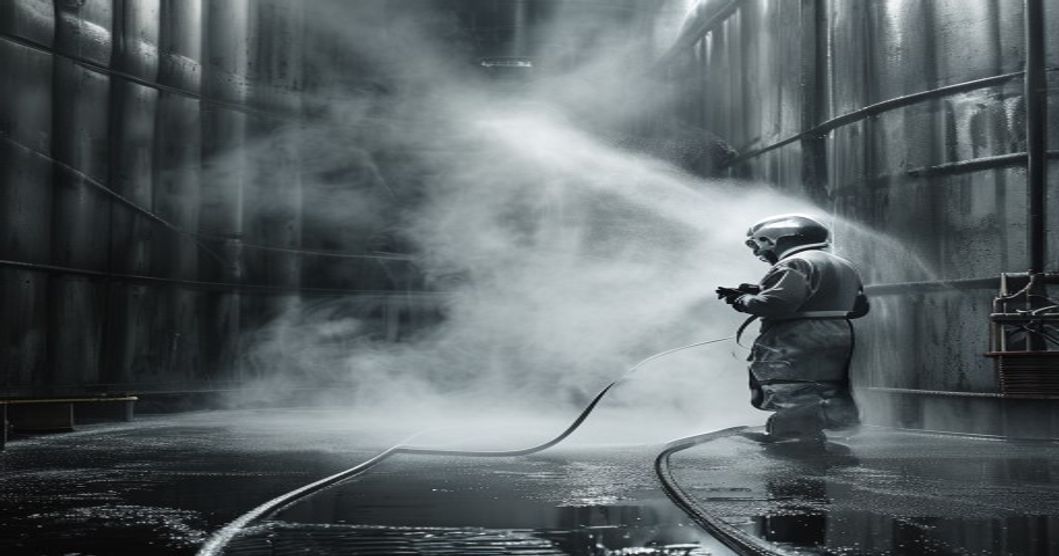
Quick answer. Polyurea tank lining is a seamless, fast-curing spray-applied coating (typically 40–125 mils / 1–3 mm) that protects steel and concrete tanks from corrosion, chemical attack, and leaks. Applied with plural-component high-pressure heated equipment at a 1:1 ratio, it gels in seconds and returns tanks to service within hours instead of days. Material plus labor typically runs $6–$18 per square foot, and the single biggest quality variable is the spray machine that mixes and heats the two components correctly.
What Is Polyurea Tank Lining?
Polyurea is a two-component elastomer formed when an isocyanate (Side A) reacts with an amine-terminated resin blend (Side B). Unlike epoxy or polyurethane, the reaction is nearly instantaneous — the coating gels in 3–15 seconds and reaches full cure in 24 hours. That speed is exactly what makes it ideal for tanks: crews can spray a monolithic, joint-free membrane across floors, walls, welds, and penetrations in a single continuous pass, eliminating the seams and pinholes where corrosion normally starts.
For storage tanks handling water, wastewater, fuels, brine, or aggressive chemicals, the result is a flexible, abrasion-resistant, chemically-inert liner that bridges hairline cracks and tolerates thermal cycling. Because it is spray-applied hot at high pressure, polyurea bonds tightly to a properly prepared substrate and can conform to any tank geometry — cylindrical, rectangular, cone-bottom, or bunded containment areas.
Polyurea vs. Epoxy, Rubber & FRP
Owners choosing a tank liner usually weigh four options. Polyurea wins on speed, seamlessness, and flexibility; the trade-off is that it demands trained applicators and precise high-pressure equipment.
| Property | Polyurea | Epoxy | Rubber Sheet | FRP |
|---|---|---|---|---|
| Cure / return to service | Seconds gel, ~24 h full | 12–72 h per coat | Days (adhesive cure) | 1–3 days per layer |
| Seamless application | Yes, monolithic | Yes, but slow | No — seams/overlaps | No — laps & joints |
| Flexibility / crack bridging | Excellent (300–500% elong.) | Brittle, low | Good | Poor |
| Abrasion resistance | Excellent | Moderate | Good | Moderate |
| Chemical resistance | Broad (grade-dependent) | Good | Product-specific | Good |
| Equipment required | High-pressure heated proportioner | Roller / airless | Manual bonding | Hand lay-up |
| Typical service life | 15–25 years | 7–12 years | 10–15 years | 10–20 years |
The practical takeaway: polyurea delivers the longest downtime-adjusted value, but only if it is sprayed at the correct temperature and pressure. That is why the equipment decision is inseparable from the coating decision.
Tank Types & Where Polyurea Fits
- Steel storage tanks — internal linings for potable water, fire-water, and process tanks; polyurea stops internal corrosion and resists cavitation at fill points.
- Concrete tanks & clarifiers — wastewater and municipal structures where polyurea bridges shrinkage cracks and resists sulfuric acid attack from H₂S off-gassing.
- Petroleum & fuel tanks — aromatic-resistant grades line bunds, tank bottoms, and dike walls; ideal for retrofitting aging above-ground tanks.
- Chemical tanks — acid, brine, and fertilizer storage; the seamless film prevents permeation into the substrate.
- Secondary containment — floors and berms that must hold 110% of the largest tank's volume under U.S. spill-prevention (SPCC) rules published by the U.S. EPA.
Explore our full application guides for tank lining spray equipment, secondary containment, and water tank lining to match a spray grade to your substrate and stored product.
Surface Prep, Spray Process & Thickness
Polyurea is only as good as the surface under it. A rushed prep is the number-one cause of premature delamination.
- Surface preparation. Abrasive blast steel to a near-white metal finish (SSPC-SP10) with a 2.5–3.5 mil angular profile; grind or shot-blast concrete to CSP 3–5. Remove all oil, moisture, and chlorides. Verify dryness and dew point before any spray.
- Priming. Apply an epoxy or moisture-tolerant primer on concrete and porous steel to lock down outgassing and boost adhesion.
- Spray application. Heat both components to 60–75 °C and atomize at 2,000–3,500 psi through a heated hose and impingement-mix gun. Maintain a 1:1 volumetric ratio and overlap passes 50% to build a uniform film.
- Mil thickness. Build 40–60 mils for water tanks, 60–80 mils for chemical/wastewater, and 80–125 mils for high-abrasion or immersion service. Confirm dry film thickness per ASTM D7091.
- Holiday (spark) test. Before returning to service, high-voltage holiday detection per ASTM G62 finds pinholes and voids so they can be repaired while crews are still on site.
Because polyurea gels in seconds, ratio and temperature errors cannot be fixed after the fact — off-ratio material stays soft or brittle permanently. This is where machine control decides whether a tank lasts 5 years or 25.
The Equipment: High-Pressure Heated Plural-Component Machines
Applying tank-grade polyurea requires a proportioner that heats both components, holds a locked 1:1 ratio under load, and delivers enough throughput to keep a continuous wet edge inside a large tank. Underpowered or unheated units produce cold spray, off-ratio streaks, and pinholes — the failures a holiday test will flag but that cost you a re-mobilization.
Pioneer Spray builds turnkey packages around exactly this duty. The JYYJ-H-V8T is our flagship high-output unit for large steel and concrete tanks, pairing dual heaters with high-pressure hydraulic pumping to sustain heavy pure-polyurea flow across big surface areas. For contractors who need portable high-pressure heated output at a lower entry cost, the JYYJ-H600PK delivers 1:1 proportioning and inline heating in a transportable frame. Mobile crews servicing multiple tank sites often choose the JYYJ-H-V6T as a mid-output workhorse that still holds full-temperature spray.
Every Pioneer Spray machine ships as a complete turnkey system — proportioner, heated hose, mix gun, and controls — engineered to spray at 25–36 MPa (3,600–5,200 psi). Compared with Graco and PMC systems of equivalent output, our turnkey packages run $3,250–$11,200, typically 30–50% below imported alternatives, with the same plural-component heating and pressure control that tank-lining specs demand. That price gap is the difference between a contractor owning the equipment outright versus renting on every job.
Cost Factors: What Actually Drives the Quote
Installed polyurea tank lining generally lands between $6 and $18 per square foot. The spread comes from a handful of levers:
| Cost Factor | Impact on Price |
|---|---|
| Mil thickness | Material scales almost linearly — 125 mils costs ~2× a 60-mil build |
| Surface prep condition | Rusted or oily substrate can double prep labor and abrasive cost |
| Polyurea grade | Chemical/immersion grades cost more than standard water grades |
| Tank geometry & access | Confined-space, overhead, and complex nozzles slow throughput |
| Owned vs. rented equipment | Owning a turnkey machine removes recurring rental from every job |
| Holiday testing & QA | Adds cost but prevents far more expensive warranty failures |
For contractors quoting recurring tank work, equipment ownership is usually the fastest ROI lever. A turnkey Pioneer Spray package often pays for itself within a handful of tank projects versus per-job rental fees, while giving crews consistent ratio and temperature control they cannot guarantee with an unfamiliar rental unit.
FAQ
Q: How thick should a polyurea tank lining be?
For potable and fire-water tanks, 40–60 mils is typical. Wastewater and chemical service usually calls for 60–80 mils, and high-abrasion or full-immersion tanks warrant 80–125 mils. Always confirm dry film thickness against your project spec.
Q: Can polyurea be applied over concrete tanks?
Yes. Concrete must be mechanically profiled to CSP 3–5, dried, and primed with a moisture-tolerant epoxy to control outgassing. Done correctly, polyurea bridges shrinkage cracks and resists the acid attack common in wastewater structures.
Q: What equipment is required to spray tank-grade polyurea?
A high-pressure, heated, plural-component proportioner that maintains a 1:1 ratio and heats both components to 60–75 °C — such as the JYYJ-H-V8T or JYYJ-H600PK. Standard airless or roller equipment cannot atomize or mix fast-set polyurea correctly.
Q: How is polyurea tank lining tested before return to service?
Applicators verify dry film thickness (ASTM D7091), check adhesion, and run high-voltage holiday detection (ASTM G62) to locate pinholes. Any flagged voids are repaired on the spot before the tank is refilled.
Q: Is a Pioneer Spray machine really cheaper than Graco or PMC?
Yes. Our turnkey high-pressure heated packages run $3,250–$11,200 — typically 30–50% below comparable Graco or PMC systems — while delivering the same 1:1 proportioning, heating, and 25–36 MPa spray pressure that tank-lining specifications require.