
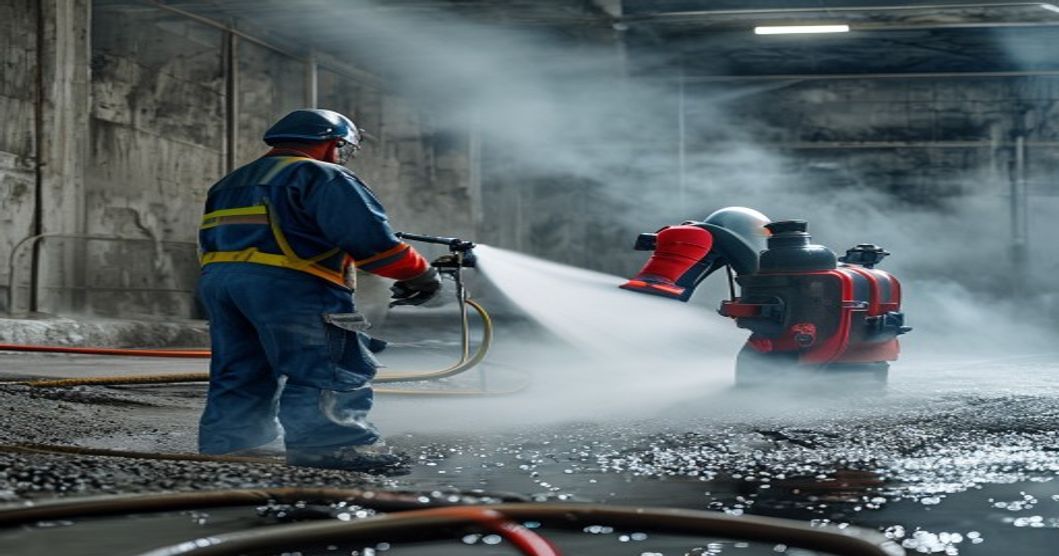
Quick answer. Polyurea secondary containment equipment is a heated, high-pressure plural-component spray system (proportioner, heated hoses, and an impingement-mixing gun) that applies a seamless, chemically resistant liner to berms, dikes, and tanks. A complete turnkey rig from Pioneer Spray runs $3,250–$11,200—typically 40–60% below comparable Graco or PMC configurations—while meeting the same throughput and mix-ratio tolerances contractors need to pass containment inspections.
Why Secondary Containment Demands Purpose-Built Spray Equipment
Secondary containment structures exist to capture leaks and spills before they reach soil or groundwater. Regulators expect these barriers to be functionally impervious. The U.S. EPA's Spill Prevention, Control, and Countermeasure (SPCC) rule requires that containment be "sufficiently impervious to contain discharged oil" for the time it takes to detect and clean up a release. A brush- or roller-applied coating rarely delivers the seamless film thickness that standard requires—but sprayed polyurea does.
Polyurea cures in seconds, bridges cracks, and forms a monolithic membrane with no cold joints. Achieving that on-site requires equipment that can heat both the isocyanate (A-side) and resin (B-side) to 150–160°F, hold a precise 1:1 volumetric ratio at 2,000–3,000 psi, and mix the components only at the gun tip. Underpowered or poorly heated machines produce soft spots, off-ratio streaking, and pinholes—the exact failure modes that fail a containment audit.
Core Components of a Containment Spray System
Every capable rig shares the same architecture. Understanding each block helps you compare quotes on equal terms rather than on headline price alone.
- Proportioner: The heart of the system. It meters A and B side, heats them, and builds pressure. Rated by output (lbs/min) and heater wattage.
- Heated hose: Keeps material at temperature from machine to gun—critical over long runs in a tank farm. Look for scuff-jacketed, temperature-controlled hose in 50 ft sections.
- Spray gun: Impingement (mechanical purge) or air-purge design. Mechanical-purge guns reduce solvent use and clogging on containment jobs with frequent stops.
- Transfer pumps & feed: Move material from drums into the proportioner without introducing air or moisture—moisture is the enemy of isocyanate chemistry.
Pioneer Spray ships these as a matched, tested package. For mid-to-large containment contractors, the hydraulic-driven JYYJ-H-V8T delivers the sustained output needed to coat large dike floors in a single mobilization, while the hydraulic spray machine platform offers a lower-cost entry with the same mix discipline.
Equipment Comparison: Matching the Rig to the Job
Containment projects range from a single 500-gallon day tank berm to a multi-acre refinery dike. Output rating is the primary selector—undersize the proportioner and gel time forces you into cold-join overlaps.
| Model | Drive | Output (approx.) | Best containment use | Turnkey price |
|---|---|---|---|---|
| Hydraulic Spray Machine | Hydraulic | ~12–18 lb/min | Small-to-mid berms, day tanks | From $3,250 |
| JYYJ-H-V8 (replaces the discontinued H800) | Hydraulic | ~20–24 lb/min | Medium dikes, loading racks | Mid-range |
| JYYJ-H-V8T | Hydraulic | ~24–30 lb/min | Large refinery/tank-farm dikes | Up to $11,200 |
Compared with a comparably specced Graco Reactor or PMC PH-2 package—often $18,000–$40,000 before hoses and gun—a Pioneer Spray turnkey rig covers the same output band at a fraction of the capital cost, with heated hose and gun included rather than sold separately.
Standards and Testing That Govern Containment Coatings
The equipment gets you a film; the standards tell you whether that film qualifies. Two references matter on nearly every job. Adhesion and film integrity are commonly verified using pull-off methods described in ASTM D4541, the standard test method for pull-off strength of coatings. Where worker exposure to isocyanate spray is a concern, applicators must follow respiratory and PPE controls consistent with OSHA's isocyanate guidance, since atomized MDI is a documented respiratory sensitizer.
Build your spec around three verifiable numbers: dry film thickness (typically 60–125 mils for chemical containment), mix ratio tolerance (±2% of 1:1), and adhesion (per D4541, matched to substrate). Equipment that can't hold temperature and pressure will drift on all three—which is precisely why a matched, tested turnkey system beats assembling mismatched parts.
Total Cost of Ownership, Not Just Sticker Price
A containment contractor's real cost is downtime and off-ratio waste, not the initial purchase. Cheap, unheated hobby rigs save $2,000 up front and cost far more in failed test panels and re-sprays. When evaluating Pioneer Spray against Graco/PMC, weigh:
- Included vs. add-on cost: Turnkey pricing bundles proportioner, heated hose, and gun—no surprise $6,000 hose bill.
- Parts availability: Standardized seals and mix chambers keep a rig producing between jobs.
- Heater capacity: Adequate wattage means you keep spraying in cold-weather containment work instead of chasing temperature.
For contractors scaling up, pairing a primary hydraulic rig with a backup keeps a containment schedule intact—two Pioneer Spray machines can still cost less than one competitor unit.
FAQ
Q: What output rating do I need for secondary containment work?
For small berms and day tanks, 12–18 lb/min is sufficient. Large refinery dikes benefit from 24–30 lb/min so you can maintain a wet edge across big floor areas without cold joints.
Q: Is polyurea equipment different from polyurethane foam equipment?
They share the plural-component architecture, but polyurea for containment runs a fast 1:1 pure-polyurea chemistry that demands tighter temperature and ratio control. Pioneer Spray rigs are configured for both, so one machine covers coating and foam work.
Q: How does Pioneer Spray pricing compare to Graco or PMC?
A comparable turnkey Pioneer Spray package runs 40–60% less than an equivalently specced Graco Reactor or PMC unit, and includes heated hose and gun that competitors typically sell as add-ons.
Q: Can these machines pass a containment inspection spec?
The equipment maintains the temperature, pressure, and 1:1 ratio needed to hit dry film thickness and adhesion targets (e.g., ASTM D4541). Passing inspection also depends on surface prep and applicator technique, but off-ratio machine failure is designed out.
Q: What safety controls do applicators need?
Because sprayed isocyanate is a respiratory sensitizer, follow OSHA isocyanate guidance: supplied-air respirators, skin protection, and ventilation. The equipment does not replace PPE controls.
Ready to spec a containment rig? Compare the full range of turnkey Pioneer Spray systems and get a matched proportioner, heated hose, and gun package sized to your project—without the Graco/PMC premium.