
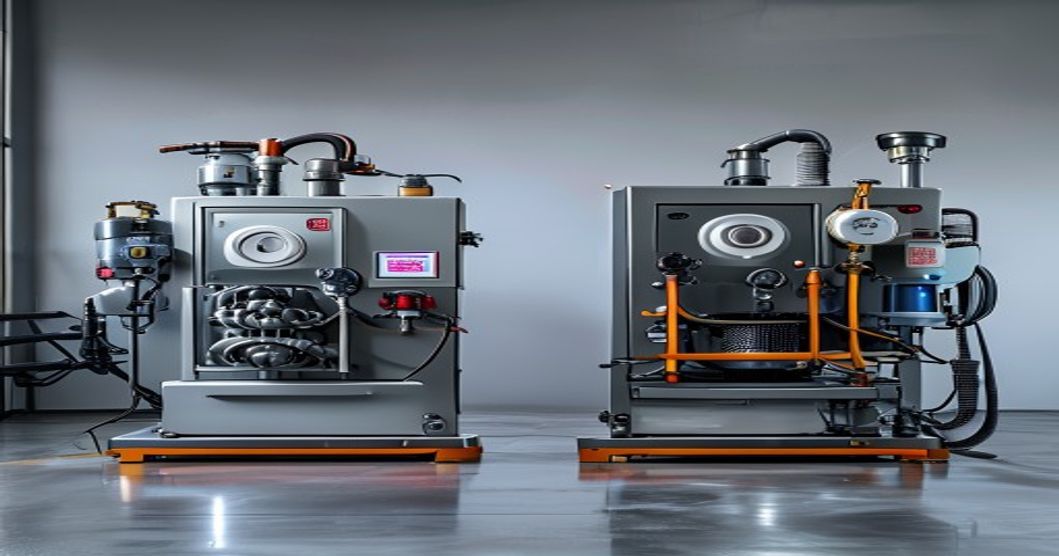
What's the Actual Difference?
Plural-component spray equipment — the rigs that meter, mix, and pump two-component polyurethane foam (SPF) or polyurea — fall into two fundamental power-train categories:
- Pneumatic (air-driven): compressed air drives reciprocating piston pumps that move Component A (polyol blend) and Component B (MDI isocyanate) through the rig
- Hydraulic (oil-driven): hydraulic oil at 1,500–3,000 PSI drives proportioning gear pumps that move A and B with high-precision metering
This is the most-debated equipment selection question in the SPF / polyurea industry, and the answer matters because the difference in real-world performance and cost can be 30–50% across multiple dimensions.
This guide gives you the decision framework based on Pioneer Spray's experience with 200+ contractor customers across both equipment types — covering output capacity, mix accuracy, maintenance cost, equipment lifespan, and which applications each is genuinely better at.
Quick Take
- Pneumatic wins on: lower acquisition cost, simpler maintenance, application versatility (can run multiple chemistries), portable
- Hydraulic wins on: higher peak output, better mix accuracy at high speeds, longer equipment lifespan, more precise temperature control
- Most US/Canadian residential / light-commercial SPF contractors use pneumatic
- Most industrial polyurea / large-commercial work uses hydraulic
- Selection rule of thumb: < 25 lb/min output target = pneumatic; > 35 lb/min = hydraulic; 25-35 lb/min = depends on application + budget
Side-by-Side Comparison
| Variable | Pneumatic | Hydraulic |
|---|---|---|
| Power source | 80+ CFM air compressor | 5–15 HP electric motor + hydraulic pump |
| Acquisition cost (mid-output) | USD 22K–35K (Pioneer) | USD 35K–55K (Pioneer) |
| Output range typical | 12–35 lb/min | 25–60+ lb/min |
| Mix accuracy | ±3–5% across operating range | ±1–2% across operating range |
| Pressure capability | Up to 2,500 PSI | Up to 3,500+ PSI |
| Operating noise | High (75–90 dB at compressor) | Low (60–75 dB) |
| Power consumption (hourly) | High (large compressor 30–60 HP) | Lower (electric motor 10–15 HP) |
| Maintenance complexity | Lower (fewer components) | Higher (hydraulic system + electric) |
| Annual maintenance cost | USD 1,500–3,000 | USD 2,500–5,000 |
| Equipment lifespan typical | 8–12 years | 10–15 years |
| Temperature precision | ±5°F (±3°C) | ±2°F (±1°C) |
| Cold-weather start performance | Better (no cold hydraulic oil) | Slower (oil viscosity warm-up) |
| Mobile / portable | Easier (smaller compressor optional) | Harder (motor + hydraulic system bulky) |
| First-time operator learning | 1–2 weeks | 2–4 weeks |
When Pneumatic Is the Right Choice
Residential SPF Contractors
For typical residential SPF work (attics, walls, retrofit insulation), pneumatic equipment dominates because:
- Output capacity of 15–22 lb/min is more than sufficient for most residential job sizes (300–2,000 ft² typical)
- Acquisition cost of USD 22K–35K is more accessible for new contractor businesses
- Maintenance simplicity means more uptime — pneumatic rigs have fewer wear components
- Compressor versatility — the 80+ CFM compressor needed for the spray rig is also useful for other contractor work (nail guns, sand blasting)
Pioneer Spray's recommended rig for residential SPF work: JYYJ H-V6T at 18 lb/min output, USD 24K base configuration.
Mobile / Trailer-Mounted Contractor Work
Trailer-mounted spray operations benefit from pneumatic configuration because:
- The compressor + spray rig combination fits in a 20-ft enclosed trailer with material drums
- Total system weight is lower (lighter trailer, easier to tow)
- Setup time at jobsite is faster (3–4 hours vs 5–6 hours for hydraulic)
Multi-Chemistry Service
If your business model involves spraying multiple chemistries (SPF, polyurea, polyaspartic, polyurethane elastomers) on different jobs, pneumatic equipment's flexibility is valuable — quick chemistry changeover with minimal downtime.
Cold-Climate Contractor Work
In cold climates (Canadian winter, Northern US), pneumatic rigs start faster — no hydraulic oil warm-up cycle required. For contractors working in Apr–Oct seasons in cold climates, this is a meaningful productivity advantage.
When Hydraulic Is the Right Choice
Industrial Polyurea Coating Work
For industrial polyurea applications (tank lining, secondary containment, port container yard coating), hydraulic equipment is the dominant choice because:
- Output capacity of 35+ lb/min matches large-volume industrial application requirements
- Mix accuracy of ±1-2% is critical for fast-cure polyurea (chemistries with <10 second pot life)
- Pressure capability of 3,000+ PSI supports the smaller atomizing tip sizes typical for industrial spray patterns
- Temperature precision of ±2°F is required for fast-cure polyurea formulations
Pioneer Spray's recommended rig for industrial polyurea: JYYJ 3H at 35 lb/min output, USD 42K base configuration.
Large Commercial SPF (Cold Storage, Warehouse, Manufacturing Facility)
For large-volume commercial SPF work:
- 100,000+ ft² jobs benefit from 35+ lb/min output rates
- Hydraulic precision keeps R-value performance consistent across the entire job
- 12–15 year equipment lifespan amortizes well across high-volume work
Multi-Crew Operations
If you operate 3+ rigs simultaneously, the hydraulic configuration:
- Standardizes maintenance schedule (similar service windows across all rigs)
- Provides better long-term reliability for production planning
- Enables centralized hydraulic service shop investment
Specialty High-Pressure Applications
For polyaspartic, polyurea elastomers, and specialty fast-cure chemistries with pot lives < 10 seconds, hydraulic precision is essentially required. Pneumatic rigs can technically run these but reliability suffers.
Decision Tree — Which Should You Buy?
Step 1: What's your primary application?
- Residential SPF / small commercial SPF / general retrofit → Pneumatic likely correct
- Industrial polyurea / large commercial / specialty coating → Hydraulic likely correct
- Mixed application → continue to Step 2
Step 2: What's your peak output requirement?
- < 25 lb/min → Pneumatic
- 25–35 lb/min → Either; budget tiebreaks (pneumatic typically 30–40% cheaper)
-
35 lb/min → Hydraulic
Step 3: What's your service environment?
- Cold climate (winter work, > 100 freeze-thaw cycles/year) → Pneumatic edge for reliability
- Hot climate (sustained 35°C+ ambient) → Either; hydraulic slightly better for sustained heat
- Coastal / salt-air → Either with stainless-trim configuration
Step 4: What's your budget tier?
- Lower budget (< USD 35K acquisition) → Pneumatic
- Higher budget (> USD 50K acquisition) → Hydraulic
- Middle (USD 35K–50K) → Either
Pioneer Spray's Pneumatic and Hydraulic Lineup
Pneumatic Rigs (Pioneer / JYYJ)
| Model | Output | Cost (USD) | Best Fit |
|---|---|---|---|
| JYYJ A-V3 | 13 lb/min | 18K–22K | Entry-level residential SPF |
| JYYJ H-V6T | 18 lb/min | 24K–28K | Standard residential SPF + light commercial |
| JYYJ H-V8T | 24 lb/min | 28K–34K | Larger residential / mid-commercial |
Hydraulic Rigs (Pioneer / JYYJ)
| Model | Output | Cost (USD) | Best Fit |
|---|---|---|---|
| JYYJ 3H | 35 lb/min | 38K–46K | Industrial polyurea / large commercial SPF |
| JYYJ 5H | 50 lb/min | 50K–62K | Heavy industrial polyurea / multi-crew operations |
See Pioneer Spray's full equipment lineup →
Frequently Asked Questions
Q: Can I run polyurea on a pneumatic rig? A: Yes — for slower-cure aliphatic polyurea formulations (pot life > 30 seconds), pneumatic rigs work fine. For fast-cure aromatic polyurea (pot life < 15 seconds), hydraulic precision is recommended for reliable mix ratio.
Q: Will a hydraulic rig be more reliable in 10-year ownership? A: Yes, typically. Hydraulic systems have fewer reciprocating wear components than pneumatic piston pumps, leading to longer service life. However, hydraulic systems are more expensive to repair when they do fail — a hydraulic pump rebuild typically costs USD 2,500–5,000 vs USD 800–1,500 for pneumatic piston pump rebuild.
Q: Can I upgrade from pneumatic to hydraulic later? A: No, the rig is purpose-built for one or the other power-train. If your business outgrows pneumatic capacity, the typical path is: keep the pneumatic rig for residential / smaller jobs, add a hydraulic rig for larger / specialty work — both rigs in service simultaneously.
Q: Which is more environmentally friendly? A: Hydraulic, marginally. Hydraulic rigs use less power per pound of foam sprayed (electric motor 10-15 HP vs pneumatic compressor 30-60 HP at full draw). Over 10-year ownership, hydraulic uses 25-40% less energy.
Q: What about weight / portability for jobsite work? A: Pneumatic wins clearly. A complete pneumatic spray system + 80 CFM compressor + 2 drums + accessories fits in a 20-ft trailer at ~6,000 lb GVW. Hydraulic system equivalent runs 7,500–9,000 lb GVW — heavier trailer, harder to maneuver, more fuel for tow vehicle.
Q: What's the noise level difference in residential neighborhoods? A: Significant. Pneumatic compressor at full output is 80–95 dB at 10 ft — this is a real issue for residential SPF work in established neighborhoods (HOA complaints, municipal noise ordinances). Hydraulic systems are 60–70 dB at 10 ft — quieter than the spray gun itself.
Next Step
If you're evaluating new equipment for your SPF / polyurea contractor business:
- Specification recommendation based on your application + output target
- Side-by-side comparison of recommended pneumatic vs hydraulic option
- Reference contact for current contractor customer using your recommended config (under NDA)
- Container quote to your nearest port for both options
Authoritative references
- OSHA — Isocyanates — Health controls every plural-component SPF operator must follow regardless of pump type.
- ECHA — Diisocyanates (EU REACH) — EU training requirement for handling the diisocyanate side of any two-component machine.